






Description
UPDATED 2014
YOUR INSURED
DEPOSITS
Federal Deposit Insurance Corporation
1
. IMPORTANT INFORMATION ABOUT THIS BROCHURE
Your Insured Deposits is a comprehensive description of FDIC deposit
insurance coverage for the most common account ownership categories.
This brochure is not intended as a legal interpretation of the FDIC’s
laws and regulations. For additional or more specific information about
FDIC insurance coverage, consult the Federal Deposit Insurance Act
(12 U.S.C.1811 et seq.) and the FDIC’s regulations relating to insurance
coverage described in 12 C.F.R. Part 330.
The information in this brochure is based on FDIC laws and regulations in
effect at publication. These rules can be amended and, therefore, some of
the information in this brochure may become outdated.
The online version of this brochure, available on the FDIC’s website at www.fdic.gov/deposit/ deposits, will be updated immediately if rule changes affecting FDIC insurance coverage are made. Depositors should note that federal law expressly limits the amount of insurance the FDIC can pay to depositors when an insured bank fails, and no representation made by any person or organization can either increase or modify that amount. This brochure is not intended to provide estate planning advice. Depositors seeking such assistance should contact a financial or legal advisor. For simplicity, this brochure uses the term “insured bank” to mean any bank or savings association that is insured by the FDIC. To check whether the FDIC insures a specific bank or savings association: • Call the FDIC toll-free: 1-877-275-3342 • Use FDIC’s “Bank Find” at: http://research.fdic.gov/bankfind/ • Look for the FDIC sign where deposits are received TABLE OF CONTENTS 2 FDIC INSURANCE COVERAGE BASICS 4 OWNERSHIP CATEGORIES 4 SINGLE ACCOUNTS 6 CERTAIN RETIREMENT ACCOUNTS 8 JOINT ACCOUNTS 11 REVOCABLE TRUST ACCOUNTS 17 IRREVOCABLE TRUST ACCOUNTS 18 EMPLOYEE BENEFIT PLAN ACCOUNTS 21 CORPORATION/PARTNERSHIP/UNINCORPORATED ASSOCIATION ACCOUNTS 22 GOVERNMENT ACCOUNTS 26 UNIQUE OWNERSHIP SCENARIOS 29 FREQUENTLY ASKED QUESTIONS SEE BACK COVER FOR MORE INFORMATION FROM THE FDIC 2 .
WHAT IS THE FDIC? The FDIC—short for the Federal Deposit Insurance Corporation—is an independent agency of the United States government. The FDIC protects depositors of insured banks located in the United States against the loss of their deposits if an insured bank fails. Any person or entity can have FDIC insurance coverage in an insured bank. A person does not have to be a U.S. citizen or resident to have his or her deposits insured by the FDIC. FDIC insurance is backed by the full faith and credit of the United States government.
Since the FDIC began operations in 1934, no depositor has ever lost a penny of FDIC-insured deposits. FDIC COVERAGE BASICS WHAT THE FDIC DOES NOT COVER • Stock investments • Bond investments • Mutual funds • Life insurance policies • Annuities • Municipal securities • Safe deposit boxes or their contents • U.S. Treasury bills, bonds or notes* *These investments are backed by the full faith and credit of the U.S. government. FDIC insurance covers depositors’ accounts at each insured bank, dollar-for-dollar, including principal and any accrued interest through the date of the insured bank’s closing, up to the insurance limit. The standard deposit insurance amount is $250,000 per depositor, per insured bank, for each account ownership category. FDIC insurance covers all types of deposits received at an insured bank but does not cover investments, even if they were purchased at an insured bank. The FDIC insures deposits that a person holds in one insured bank separately from any deposits that the person owns in another separately chartered insured bank. For example, if a person has a certificate of deposit at Bank A and has a certificate of deposit at Bank B, the amounts would each be insured separately up to $250,000.
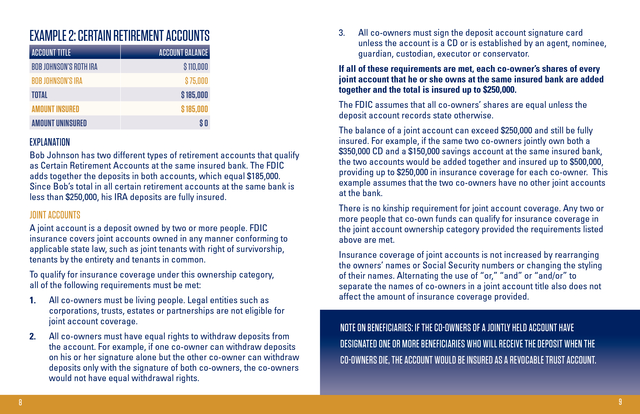
Funds deposited in separate branches of the same insured bank are not separately insured. WHAT THE FDIC COVERS • Checking accounts • Negotiable Order of Withdrawal (NOW) accounts • Savings accounts • Money market deposit accounts (MMDA) • Time deposits such as certificates of deposit (CDs) • Cashier’s checks, money orders, and other official items issued by a bank 2 The FDIC provides separate insurance coverage for funds depositors may have in different categories of legal ownership. The FDIC refers to these different categories as “ownership categories.” This means that a bank customer who has multiple accounts may qualify for more than $250,000 in insurance coverage if the customer’s funds are deposited in different ownership categories and the requirements for each ownership category are met. 3 . OWNERSHIP CATEGORIES This section describes the following FDIC ownership categories and the requirements a depositor must meet to qualify for insurance coverage above $250,000 at one insured bank. If an account title identifies only one owner, but another person has the right to withdraw funds from the account (e.g., as Power of Attorney or custodian), the FDIC will insure the account as a single ownership account. • Single Accounts • Certain Retirement Accounts • Joint Accounts • Revocable Trust Accounts • Irrevocable Trust Accounts • Employee Benefit Plan Accounts • Corporation/Partnership/Unincorporated Association Accounts • Government Accounts The FDIC adds together all single accounts owned by the same person at the same bank and insures the total up to $250,000. SINGLE ACCOUNTS ACCOUNT TITLE MARCI JONES MARCI JONES MARCI JONES MARCI’S MEMORIES (A SOLE PROPRIETORSHIP) TOTAL AMOUNT INSURED AMOUNT UNINSURED A single account is a deposit owned by one person. This ownership category includes: • An account held in one person’s name only, provided the owner has not designated any beneficiary(ies) who are entitled to receive the funds when the account owner dies • An account established for one person by an agent, nominee, guardian, custodian, or conservator, including Uniform Transfers to Minors Act accounts, escrow accounts and brokered deposit accounts • An account held in the name of a business that is a sole proprietorship (for example, a “Doing Business As” or DBA account) • An account established for or representing a deceased person’s funds—commonly known as a decedent’s estate account • An account that fails to qualify for separate coverage under another ownership category 4 NOTE ON BENEFICIARIES: IF THE OWNER OF A SINGLE ACCOUNT HAS DESIGNATED ONE OR MORE BENEFICIARIES WHO WILL RECEIVE THE DEPOSIT WHEN THE ACCOUNT OWNER DIES, THE ACCOUNT WOULD BE INSURED AS A REVOCABLE TRUST ACCOUNT. EXAMPLE 1: SINGLE ACCOUNT DEPOSIT TYPE MMDA SAVINGS CD CHECKING ACCOUNT BALANCE $ 15,000 $ 20,000 $ 200,000 $ 25,000 $ 260,000 $ 250,000 $ 10,000 EXPLANATION Marci Jones has four single accounts at the same insured bank, including one account in the name of her business, which is a sole proprietorship. The FDIC insures deposits owned by a sole proprietorship as the single account of the business owner. The FDIC combines the four accounts, which equal $260,000, and insures the total balance up to $250,000, leaving $10,000 uninsured. 5 . CERTAIN RETIREMENT ACCOUNTS A retirement account is insured under the Certain Retirement Accounts ownership category only if the account qualifies as one of the following: • Individual Retirement Account (IRA): »» Traditional IRA »» Roth IRA »» Simplified Employee Pension (SEP) IRA »» Savings Incentive Match Plans for Employees (SIMPLE) IRA • Self-directed defined contribution plan account includes »» Self-directed 401(k) plan »» Self-directed SIMPLE IRA held in the form of a 401(k) plan »» Self-directed defined contribution profit-sharing plan • Self-directed Keogh plan account (or H.R.10 plan account) designed for self-employed individuals • Section 457 deferred compensation plan account, such as an eligible deferred compensation plan provided by state and local governments regardless of whether the plan is self-directed The FDIC adds together all retirement accounts listed above owned by the same person at the same insured bank and insures the total amount up to $250,000. The FDIC defines the term “self-directed” to mean that plan participants have the right to direct how the money is invested, including the ability to direct that deposits be placed at an FDIC-insured bank. The FDIC will consider an account to be self-directed if the participant of the retirement plan has the right to choose a particular bank’s deposit accounts as an investment option. For example: 6 • If a plan has deposit accounts at a particular insured bank as its default investment option, then the FDIC would deem the plan to be self-directed for insurance coverage purposes because, by inaction, the participant has directed the placement of such deposits • If a plan consists only of a single employer/employee, and the employer establishes the plan with a single investment option of deposit accounts at a particular insured bank, then the plan would be considered self-directed for insurance coverage purposes The following types of deposits do not qualify as Certain Retirement Accounts: • A plan for which the only investment vehicle is the deposit accounts of a particular bank, so that participants have no choice of investments • Deposit accounts established under section 403(b) of the Internal Revenue Code (annuity contracts for certain employees of public schools, tax-exempt organizations and ministers), which are insured as Employee Benefit Plan accounts • Defined-benefit plan deposits (plans for which the benefits are determined by an employee’s compensation, years of service and age), which are insured as Employee Benefit Plan accounts • Defined contribution plans that are not self-directed, which are insured as Employee Benefit Plan Accounts • Coverdell Education Savings Accounts (formerly known as Education IRAs), Health Savings Accounts or Medical Savings Accounts (see the section on Unique Ownership Situations for guidance on the deposit insurance coverage) NOTE ON BENEFICIARIES: WHILE SOME SELF-DIRECTED RETIREMENT ACCOUNTS, LIKE IRAS, PERMIT THE OWNER TO NAME ONE OR MORE BENEFICIARIES, THE EXISTENCE OF BENEFICIARIES DOES NOT INCREASE THE AVAILABLE INSURANCE COVERAGE. 7 . EXAMPLE 2: CERTAIN RETIREMENT ACCOUNTS ACCOUNT TITLE BOB JOHNSON’S ROTH IRA BOB JOHNSON’S IRA TOTAL AMOUNT INSURED AMOUNT UNINSURED ACCOUNT BALANCE $ 110,000 $ 75,000 $ 185,000 $ 185,000 $0 EXPLANATION Bob Johnson has two different types of retirement accounts that qualify as Certain Retirement Accounts at the same insured bank. The FDIC adds together the deposits in both accounts, which equal $185,000. Since Bob’s total in all certain retirement accounts at the same bank is less than $250,000, his IRA deposits are fully insured. JOINT ACCOUNTS A joint account is a deposit owned by two or more people. FDIC insurance covers joint accounts owned in any manner conforming to applicable state law, such as joint tenants with right of survivorship, tenants by the entirety and tenants in common. To qualify for insurance coverage under this ownership category, all of the following requirements must be met: 1. All co-owners must be living people.
Legal entities such as corporations, trusts, estates or partnerships are not eligible for joint account coverage. 2. All co-owners must have equal rights to withdraw deposits from the account. For example, if one co-owner can withdraw deposits on his or her signature alone but the other co-owner can withdraw deposits only with the signature of both co-owners, the co-owners would not have equal withdrawal rights. 8 3.
All co-owners must sign the deposit account signature card unless the account is a CD or is established by an agent, nominee, guardian, custodian, executor or conservator. If all of these requirements are met, each co-owner’s shares of every joint account that he or she owns at the same insured bank are added together and the total is insured up to $250,000. The FDIC assumes that all co-owners’ shares are equal unless the deposit account records state otherwise. The balance of a joint account can exceed $250,000 and still be fully insured. For example, if the same two co-owners jointly own both a $350,000 CD and a $150,000 savings account at the same insured bank, the two accounts would be added together and insured up to $500,000, providing up to $250,000 in insurance coverage for each co-owner. This example assumes that the two co-owners have no other joint accounts at the bank. There is no kinship requirement for joint account coverage.
Any two or more people that co-own funds can qualify for insurance coverage in the joint account ownership category provided the requirements listed above are met. Insurance coverage of joint accounts is not increased by rearranging the owners’ names or Social Security numbers or changing the styling of their names. Alternating the use of “or,” “and” or “and/or” to separate the names of co-owners in a joint account title also does not affect the amount of insurance coverage provided. NOTE ON BENEFICIARIES: IF THE CO-OWNERS OF A JOINTLY HELD ACCOUNT HAVE DESIGNATED ONE OR MORE BENEFICIARIES WHO WILL RECEIVE THE DEPOSIT WHEN THE CO-OWNERS DIE, THE ACCOUNT WOULD BE INSURED AS A REVOCABLE TRUST ACCOUNT. 9 . EXAMPLE 3: JOINT ACCOUNTS ACCOUNT TITLE MARY AND JOHN SMITH MARY OR JOHN SMITH MARY OR JOHN OR ROBERT SMITH TOTAL DEPOSIT TYPE MMDA SAVINGS CD REVOCABLE TRUST ACCOUNTS ACCOUNT BALANCE SHARE PER OWNER $ 230,000 $ 115,000 $ 300,000 $ 150,000 $ 270,000 $ 90,000 $ 800,000 INSURANCE COVERAGE FOR EACH OWNER IS CALCULATED AS FOLLOWS: OWNERS MARY JOHN ROBERT TOTAL TOTAL OF ALL OWNERSHIP SHARES AMOUNT INSURED $ 355,000 $ 250,000 $ 355,000 $ 250,000 $ 90,000 $ 90,000 $ 800,000 $ 590,000 AMOUNT UNINSURED $ 105,000 $ 105,000 $0 $ 210,000 EXPLANATION • The total amount in each joint account is divided by the number of co-owners. • Mary’s ownership share in all joint accounts equals 1/2 of the MMDA account ($115,000), 1/2 of the savings account ($150,000), and 1/3 of the CD ($90,000), for a total of $355,000. Since her coverage in the joint account ownership category is limited to $250,000, $105,000 is uninsured. • John’s ownership share in all joint accounts is the same as Mary’s, so $105,000 of John’s deposits is uninsured. • Robert’s ownership share in all joint accounts equals 1/3 of the CD, or $90,000, so his share is fully insured. 10 This section explains FDIC insurance coverage for revocable trust accounts, and is not intended as estate planning advice or guidance. Depositors should contact a legal or financial advisor for assistance with estate planning. A revocable trust account is a deposit account owned by one or more people that identifies one or more beneficiaries who will receive the deposits upon the death of the owner(s). A revocable trust can be revoked, terminated or changed at any time, at the discretion of the owner(s). In this section, the term “owner” means the grantor, settlor, or trustor of the revocable trust. When calculating deposit insurance coverage, the designation of trustees, co-trustees and successor trustees is not relevant.
They are administrators and are not considered in calculating deposit insurance coverage. This ownership category includes both informal and formal revocable trusts: • Informal revocable trusts—often called payable on death, Totten trust, in trust for, or as trustee for accounts—are created when the account owner signs an agreement, usually part of the bank’s signature card, directing the bank to transfer the funds in the account to one or more named beneficiaries upon the owner’s death. • Formal revocable trusts—known as living or family trusts—are written trusts created for estate planning purposes. The owner controls the deposits and other assets in the trust during his or her lifetime. The agreement establishes that the deposits are to be paid to one or more identified beneficiaries upon the owner’s death.
The trust generally becomes irrevocable upon the owner’s death. 11 . COVERAGE AND REQUIREMENTS FOR REVOCABLE TRUST ACCOUNTS owner, the beneficiaries’ interests and the amount of the deposit. In general, the owner of a revocable trust account is insured up to $250,000 for each unique beneficiary, if all of the following requirements are met: Two calculation methods are used to determine insurance coverage of revocable trust accounts: one method is used only when a revocable trust owner has five or fewer unique beneficiaries; the other method is used only when an owner has six or more unique beneficiaries. 1. The account title at the bank must indicate that the account is held pursuant to a trust relationship. This rule can be met by using the terms payable on death (or POD), in trust for (or ITF), as trustee for (or ATF), living trust, family trust, or any similar language, including simply having the word “trust” in the account title. The account title includes information contained in the bank’s electronic deposit account records. 2.
The beneficiaries must be named in either the deposit account records of the bank (for informal revocable trusts) or identified in the formal revocable trust document. For a formal trust agreement, it is acceptable for the trust to use language such as “my issue” or other commonly used legal terms to describe the designated beneficiaries, provided the specific names and number of eligible beneficiaries can be determined. 3. To qualify as an eligible beneficiary, the beneficiary must be a living person, a charity or a non-profit organization.
If a charity or nonprofit organization is named as beneficiary, it must qualify as such under Internal Revenue Service (IRS) regulations. An account must meet all of the above requirements to be insured under the revocable trust ownership category. Typically, if any of the above requirements are not met, the entire amount in the account, or the portion of the account that does not qualify, is added to the owner’s other single accounts, if any, at the same bank and insured up to $250,000. If the trust has multiple co-owners, each owner’s share of the non-qualifying amount would be treated as his or her single ownership account. Insurance coverage for revocable trust accounts is calculated differently depending on the number of beneficiaries named by the 12 If a trust has more than one owner, each owner’s insurance coverage is calculated separately. REVOCABLE TRUST INSURANCE COVERAGE – FIVE OR FEWER UNIQUE BENEFICIARIES When a revocable trust owner names five or fewer beneficiaries, the owner’s trust deposits are insured up to $250,000 for each unique beneficiary. This rule applies to the combined interests of all beneficiaries the owner has named in all formal and informal revocable trust accounts at the same bank.
When there are five or fewer beneficiaries, maximum deposit insurance coverage for each trust owner is determined by multiplying $250,000 times the number of unique beneficiaries, regardless of the dollar amount or percentage allotted to each unique beneficiary. Therefore, a revocable trust with five unique beneficiaries is insured up to $1,250,000. MAXIMUM INSURANCE COVERAGE FOR A TRUST OWNER WHEN THERE ARE FIVE OR FEWER UNIQUE BENEFICIARIES: NUMBER OF UNIQUE BENEFICIARIES 1 BENEFICIARY 2 BENEFICIARIES 3 BENEFICIARIES 4 BENEFICIARIES 5 BENEFICIARIES MAXIMUM DEPOSIT INSURANCE COVERAGE $ 250,000 $ 500,000 $ 750,000 $1,000,000 $1,250,000 13 . EXAMPLE 4: POD ACCOUNTS FOR ONE OWNER WHEN THERE ARE FIVE OR FEWER UNIQUE BENEFICIARIES ACCOUNT TITLE JOHN JONES POD JOHN JONES POD JOHN JONES POD TOTAL AMOUNT INSURED AMOUNT UNINSURED OWNER JOHN JOHN JOHN BENEFICIARIES JACK, JANET JACK, JANET JACK, JANET DEPOSIT TYPE MMDA SAVINGS CD EXPLANATION ACCOUNT BALANCE $ 10,000 $ 20,000 $ 470,000 $ 500,000 $ 500,000 $0 EXPLANATION John Jones has three revocable trust accounts at the same insured bank. For each of these accounts, John has named the same two unique beneficiaries. Maximum insurance coverage for these accounts is calculated as $250,000 times two beneficiaries, which equals $500,000. John Jones is fully insured. EXAMPLE 5: MULTIPLE REVOCABLE TRUST ACCOUNTS WITH FIVE OR FEWER UNIQUE BENEFICIARIES ACCOUNT NUMBER ACCOUNT OWNER(S) PAUL & LISA LI 1 (LIVING TRUST) LISA LI 2 (POD) OWNERS BENEFICIARIES PAUL JOHN, SHARON LISA JOHN, SHARON, BILL TOTAL 14 ACCOUNT BENEFICIARIES ACCOUNT BALANCE JOHN AND SHARON LI $700,000 SHARON AND BILL LI $450,000 OWNER’S SHARE $ 350,000 $ 800,000 $1,150,000 AMOUNT INSURED $ 350,000 $ 750,000 $1,100,000 When a revocable trust owner names five or fewer beneficiaries, the owner’s share of each trust account is added together and the owner receives up to $250,000 in insurance coverage for each unique beneficiary. • Paul’s share: $350,000 (50% of Account 1) • Lisa’s share: $800,000 (50% of Account 1 and 100% of Account 2) Because Paul named two unique beneficiaries, his maximum insurance coverage is $500,000 ($250,000 times two beneficiaries).
Since his share of Account 1- $350,000 - is less than $500,000, he is fully insured. Because Lisa has named three unique beneficiaries between Accounts 1 and 2, her maximum insurance coverage is $750,000 ($250,000 times three beneficiaries). Since her share of both accounts - $800,000 exceeds $750,000, she is uninsured for $50,000. REVOCABLE TRUST INSURANCE COVERAGE - SIX OR MORE UNIQUE BENEFICIARIES Equal Beneficial Interests When a revocable trust owner names six or more unique beneficiaries, and all the beneficiaries have an equal interest in the trust (i.e., every beneficiary receives exactly the same amount), the insurance calculation is the same as for revocable trusts that name five or fewer beneficiaries. The trust owner receives insurance coverage up to $250,000 for each unique beneficiary.
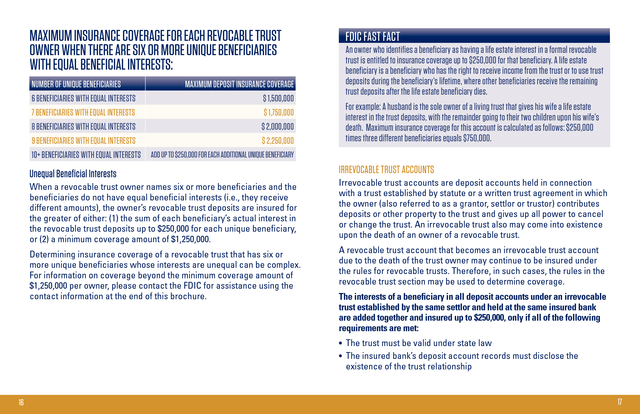
As shown below, with one owner and six beneficiaries, with equal beneficial interests, the owner’s maximum insurance coverage is up to $1,500,000. AMOUNT UNINSURED $0 $ 50,000 $ 50,000 15 . MAXIMUM INSURANCE COVERAGE FOR EACH REVOCABLE TRUST OWNER WHEN THERE ARE SIX OR MORE UNIQUE BENEFICIARIES WITH EQUAL BENEFICIAL INTERESTS: NUMBER OF UNIQUE BENEFICIARIES 6 BENEFICIARIES WITH EQUAL INTERESTS 7 BENEFICIARIES WITH EQUAL INTERESTS 8 BENEFICIARIES WITH EQUAL INTERESTS 9 BENEFICIARIES WITH EQUAL INTERESTS 10+ BENEFICIARIES WITH EQUAL INTERESTS MAXIMUM DEPOSIT INSURANCE COVERAGE $ 1,500,000 $ 1,750,000 $ 2,000,000 $ 2,250,000 FDIC FAST FACT An owner who identifies a beneficiary as having a life estate interest in a formal revocable trust is entitled to insurance coverage up to $250,000 for that beneficiary. A life estate beneficiary is a beneficiary who has the right to receive income from the trust or to use trust deposits during the beneficiary’s lifetime, where other beneficiaries receive the remaining trust deposits after the life estate beneficiary dies. For example: A husband is the sole owner of a living trust that gives his wife a life estate interest in the trust deposits, with the remainder going to their two children upon his wife’s death. Maximum insurance coverage for this account is calculated as follows: $250,000 times three different beneficiaries equals $750,000. ADD UP TO $250,000 FOR EACH ADDITIONAL UNIQUE BENEFICIARY Unequal Beneficial Interests When a revocable trust owner names six or more beneficiaries and the beneficiaries do not have equal beneficial interests (i.e., they receive different amounts), the owner’s revocable trust deposits are insured for the greater of either: (1) the sum of each beneficiary’s actual interest in the revocable trust deposits up to $250,000 for each unique beneficiary, or (2) a minimum coverage amount of $1,250,000. Determining insurance coverage of a revocable trust that has six or more unique beneficiaries whose interests are unequal can be complex. For information on coverage beyond the minimum coverage amount of $1,250,000 per owner, please contact the FDIC for assistance using the contact information at the end of this brochure. IRREVOCABLE TRUST ACCOUNTS Irrevocable trust accounts are deposit accounts held in connection with a trust established by statute or a written trust agreement in which the owner (also referred to as a grantor, settlor or trustor) contributes deposits or other property to the trust and gives up all power to cancel or change the trust. An irrevocable trust also may come into existence upon the death of an owner of a revocable trust. A revocable trust account that becomes an irrevocable trust account due to the death of the trust owner may continue to be insured under the rules for revocable trusts.
Therefore, in such cases, the rules in the revocable trust section may be used to determine coverage. The interests of a beneficiary in all deposit accounts under an irrevocable trust established by the same settlor and held at the same insured bank are added together and insured up to $250,000, only if all of the following requirements are met: • The trust must be valid under state law • The insured bank’s deposit account records must disclose the existence of the trust relationship 16 17 . • The beneficiaries and their interests in the trust must be identifiable from the bank’s deposit account records or from the trustee’s records • The amount of each beneficiary’s interest must not be contingent as defined by FDIC regulations If the owner retains an interest in the trust, then the amount of the owner’s retained interest would be added to the owner’s other single accounts, if any, at the same insured bank and the total insured up to $250,000. For example, if the grantor of an irrevocable trust is still living, and the trust provides that trust assets can either be used by the grantor or by a trustee on behalf of the grantor, the grantor would be deemed to have a retained interest. Thus, this irrevocable trust account would not be insured under the irrevocable trust ownership category, but as a single ownership deposit of the grantor. The balance of the account would be added together with any other single ownership accounts the grantor has at the same bank, and the total would be insured up to $250,000. FDIC FAST FACT Since irrevocable trusts usually contain conditions that affect the interests of the beneficiaries or provide a trustee or a beneficiary with the authority to invade the principal, insurance coverage for an irrevocable trust account usually is limited to $250,000. An owner or trustee of an irrevocable trust account who is unsure of the provisions of the trust should consult a legal or financial advisor. EMPLOYEE BENEFIT PLAN ACCOUNTS An employee benefit plan account is a deposit of a pension plan, defined benefit plan or other employee benefit plan that is not selfdirected. An account insured under this category must meet the definition of an employee benefit plan in section 3(3) of the Employee Retirement Income Security Act (ERISA) of 1974, with the exception of plans that qualify under the Certain Retirement Account ownership 18 category.
The FDIC does not insure the plan itself, but insures the deposit accounts owned by the plan. Additional requirements for coverage: • The investment and management decisions relating to the account must be controlled by a plan administrator (not self-directed by the participant). • The plan administrator must maintain documentation supporting the plan and the beneficial interest of the participants • The account must be properly titled as an employee benefit account with the bank »» When all of these requirements are met, the FDIC will insure each participant’s interest in the plan up to $250,000, separately from any accounts the employer or employee may have in the same FDIC insured institution. The FDIC often refers to this coverage as “passthrough coverage” because the insurance coverage passes through the employer (agent) that established the account to the employee who is considered the owner of the funds. Even when plans qualify for pass-through coverage, insurance coverage cannot be determined simply by multiplying the number of participants by $250,000 because plan participants frequently have different interests in the plan. To determine the maximum amount a plan can have on deposit in a single bank and remain fully insured, the plan administrator must first identify the participant who has the largest share of the plan assets, and calculate the participant’s share as a percentage of overall plan assets. Then, the plan administrator must divide $250,000 by that percentage to arrive at the maximum fully insured amount that a plan can have on deposit at one bank. 19 .
EXAMPLE 6: EMPLOYEE BENEFIT PLAN THAT QUALIFIES FOR PASS-THROUGH COVERAGE The Happy Pet Vet Clinic has a profit-sharing plan for its employees ACCOUNT TITLE HAPPY PET VET CLINIC BENEFIT PLAN PLAN PARTICIPANTS DR. TODD DR. JONES TECH EVANS TECH BARNES PLAN TOTAL BALANCE $700,000 PLAN SHARE SHARE OF DEPOSIT AMOUNT INSURED AMOUNT UNINSURED 35% $ 245,000 $ 245,000 $0 30% $ 210,000 $ 210,000 $0 20% $ 140,000 $ 140,000 $0 15% $ 105,000 $ 105,000 $0 100% $ 700,000 $ 700,000 $0 EXPLANATION This employee benefit plan’s $700,000 deposit is fully insured. Because Dr.
Todd’s share of the $700,000 deposit (35% of $700,000 = $245,000) is less than $250,000, and all of the other participants’ shares of the deposit also are less than $250,000, the entire deposit is insured. To determine the maximum amount this employee benefit plan can deposit at one bank and ensure all of the funds are fully covered, $250,000 should be divided by the percentage share of the plan participant with the largest interest in the plan. In this example, the maximum fully insured balance for this plan is $714,285. This amount is calculated as follows: $250,000 divided by 35% or 0.35 = $714,285. Plan participants who want to know more about how an employee benefit plan’s deposits are insured should consult with the plan administrator. 20 FDIC FAST FACT Employee benefit plan deposits that do not qualify for pass-through coverage, such as health and welfare plans, are insured up to $250,000 per bank.
Health and welfare plans usually do not qualify for pass-through coverage because the interests of the participants are not ascertainable. A participant will receive payments from the plan based on claims he or she files independent of any specific ownership interest in the plan. CORPORATION/PARTNERSHIP/UNINCORPORATED ASSOCIATION ACCOUNTS Deposits owned by corporations, partnerships, and unincorporated associations, including for-profit and not-for-profit organizations, are insured under the same ownership category. Such deposits are insured separately from the personal deposits of the organization’s owners, stockholders, partners or members. Unincorporated associations typically insured under this category include churches and other religious organizations, community and civic organizations and social clubs. To qualify for insurance coverage under this ownership category, a corporation, partnership or unincorporated association must be engaged in an “independent activity,” meaning that the entity is operated primarily for some purpose other than to increase deposit insurance coverage. All deposits owned by a corporation, partnership, or unincorporated association at the same bank are combined and insured up to $250,000. Accounts owned by the same corporation, partnership, or unincorporated association but designated for different purposes are not separately insured. For example: If a corporation has both an operating account and a reserve account at the same bank, the FDIC would add both accounts together and insure the deposits up to $250,000.
Similarly, if a corporation has divisions or units that are not separately incorporated, the FDIC would combine the deposit accounts of those divisions or units 21 . with any other deposit accounts of the corporation at the bank and the total would be insured up to $250,000. The number of partners, members, stockholders or account signatories established by a corporation, partnership or unincorporated association does not affect insurance coverage. For example: The FDIC insures deposits owned by a homeowners’ association at one insured bank up to $250,000 in total, not $250,000 for each member of the association. FDIC FAST FACT Accounts held in the name of a sole proprietorship are not insured under this ownership category. Rather, they are insured as the single account deposits of the owner, added to the owner’s other single accounts, if any, at the same bank and the total insured up to $250,000. GOVERNMENT ACCOUNTS The category known as government accounts (also called Public Unit accounts) includes deposit accounts owned by: • The United States, including federal agencies • Any state, county, municipality (or a political subdivision of any state, county or municipality), the District of Columbia, Puerto Rico and other government possessions and territories • An Indian tribe Insurance coverage of a government account is unique in that the insurance coverage extends to the official custodian of the deposits belonging to the government or public unit, rather than to the government unit itself. Accounts held by an official custodian of a government unit will be insured as follows: 22 In-state accounts: • Up to $250,000 for the combined amount of all time and savings accounts (including NOW accounts) • Up to $250,000 for the combined amount of all interest-bearing and noninterest-bearing demand deposit accounts (since July 21, 2011, banks have been allowed to pay interest on demand deposit accounts) Out-of-state accounts: • up to $250,000 for the combined amount of all deposit accounts FDIC FAST FACT A Negotiable Order of Withdrawal (NOW) account is a savings deposit - not a demand deposit account. To learn more about deposit insurance coverage for Government Accounts, see the FDIC’s Fact Sheet – Deposit Insurance for Accounts Held by Government Depositors at: www.fdic.gov/deposit/deposits/factsheet.html PUTTING IT ALL TOGETHER: USING MULTIPLE OWNERSHIP CATEGORIES The FDIC provides separate insurance coverage for a depositor’s funds at the same insured bank if the deposits are held in different ownership categories. To qualify for this expanded coverage, the requirements for insurance coverage in each ownership category must be met. The example on the next page illustrates how a husband and wife with three children could qualify for up to $3,500,000 in FDIC coverage at one insured bank. This example assumes that the funds are in qualified deposit products at an insured bank and these are the only accounts that the family has at the bank. Note: This example is intended solely to describe the use of different account ownership categories and not to provide estate planning advice. 23 .
EXAMPLE 7: INSURANCE COVERAGE FOR A HUSBAND AND WIFE WITH DEPOSIT ACCOUNTS IN MULTIPLE OWNERSHIP CATEGORIES ACCOUNT TITLE HUSBAND WIFE ACCOUNT OWNERSHIP CATEGORY SINGLE ACCOUNT SINGLE ACCOUNT OWNER(S) BENEFICIARY(IES) MAXIMUM INSURABLE AMOUNT $ 250,000 WIFE $ 250,000 Revocable Trust Account Ownership Category $ 500,000 To determine insurance coverage of revocable trust accounts, the FDIC first determines the amount of the trust’s deposits belonging to each owner. In this example: HUSBAND $ 250,000 HUSBAND & WIFE REVOCABLE HUSBAND & LIVING TRUST TRUST ACCOUNT WIFE CHILD 1 CHILD 2 CHILD 3 $ 1,500,000 HUSBAND IRA WIFE IRA WIFE $ 250,000 HUSBAND $ 250,000 WIFE $ 250,000 TOTAL $3,500,000 EXPLANATION Single Account Ownership Category The FDIC combines all single accounts owned by the same person at the same bank and insures the total up to $250,000. The Husband’s single account deposits do not exceed $250,000 so his funds are fully insured. The same facts apply to the Wife’s single account deposits. Both accounts are fully insured. 24 Husband and Wife have one joint account at the bank.
The FDIC combines each co-owner’s shares of all joint accounts at the bank and insures each co-owner’s total up to $250,000. Husband’s ownership share in all joint accounts at the bank equals ½ of the joint account or $250,000, so his share is fully insured. Wife’s ownership share in all joint accounts at the bank equals ½ of the joint account or $250,000, so her share is fully insured. HUSBAND HUSBAND & WIFE JOINT ACCOUNT HUSBAND & WIFE REVOCABLE HUSBAND POD TRUST ACCOUNT HUSBAND REVOCABLE WIFE POD TRUST ACCOUNT WIFE CERTAIN RETIREMENT ACCOUNT CERTAIN RETIREMENT ACCOUNT Joint Account Ownership Category • Husband’s share = $1,000,000 (100% of the Husband’s POD account naming Wife as beneficiary and 50% of the Husband and Wife Living Trust account identifying Child 1, Child 2, and Child 3 as beneficiaries) • Wife’s share = $1,000,000 (100% of the Wife’s POD account naming Husband as beneficiary and 50% of the Husband and Wife Living Trust account identifying Child 1, Child 2, and Child 3 as beneficiaries) Second, the FDIC determines the number of beneficiaries for each owner.
In this example, each owner has four unique beneficiaries (Spouse, Child 1, Child 2 and Child 3). When a revocable trust owner names five or fewer unique beneficiaries, the owner is insured up to $250,000 for each unique beneficiary. Husband’s share of the revocable trust deposits is insured up to $1,000,000 ($250,000 times four beneficiaries = $1,000,000).
Wife’s share of the revocable trust deposits is insured up to $1,000,000 ($250,000 times four beneficiaries = $1,000,000). 25 . Certain Retirement Account Ownership Category How does the FDIC insure funds deposited by a fiduciary? The FDIC adds together all certain retirement accounts owned by the same person at the same bank and insures the total up to $250,000. The Husband and Wife each have an IRA deposit at the bank with a balance of $250,000. Because each account is within the insurance limit, the funds are fully insured. Funds deposited by a fiduciary on behalf of a person or entity (the owner) are insured as the deposits of the owner if the disclosure requirements for fiduciary accounts are met. UNIQUE OWNERSHIP SCENARIOS Funds deposited by a fiduciary on behalf of a person or entity (the owner) are added to any other deposits the owner holds in the same ownership category at the same bank, and insured up to the applicable limit. FIDUCIARY ACCOUNTS What are fiduciary accounts? Fiduciary accounts are deposit accounts owned by one party but held in a fiduciary capacity by another party. Fiduciary relationships may include, but are not limited to, an agent, nominee, guardian, executor or custodian. Common fiduciary accounts include Uniform Transfers to Minors Act accounts, escrow accounts, Interest On Lawyer Trust Accounts and deposit accounts obtained through a broker. What are the FDIC requirements for fiduciary accounts? The fiduciary nature of the account must be disclosed in the bank’s deposit account records (e.g., “Jane Doe as Custodian for Susie Doe” or “First Real Estate Title Company, Client Escrow Account”).
The name and ownership interest of each owner must be ascertainable from the deposit account records of the insured bank or from records maintained by the agent (or by some person or entity that has agreed to maintain records for the agent). Special disclosure rules apply to multi-tiered fiduciary relationships. If an agent pools the deposits of several owners into one account and the disclosure rules are satisfied, the deposits of each owner will be insured as that owner’s deposits. 26 Are funds deposited by a fiduciary insured separately from an owner’s other deposit accounts at the same bank? For Example: A broker purchases a CD for $250,000 on a customer’s behalf at ABC Bank. The customer already has a checking account in his or her name at ABC Bank for $15,000. The two accounts are added together and insured up to $250,000 in the single ownership account category.
Since the customer’s single ownership deposits total $265,000, $15,000 is uninsured. HEALTH SAVINGS ACCOUNTS What is a Health Savings Account? A Health Savings Account (HSA) is an IRS qualified tax-exempt trust or custodial deposit that is established with a qualified HSA trustee, such as an FDIC-insured bank, to pay or reimburse a depositor for certain medical expenses. How does the FDIC insure an HSA? An HSA, like any other deposit, is insured based on who owns the funds and whether beneficiaries have been named. If a depositor opens an HSA and names beneficiaries either in the HSA agreement or in the bank’s records, the FDIC would insure the deposit under the Revocable Trust Account ownership category. If a depositor opens an HSA and does not name any beneficiaries, the FDIC would insure the deposit under the single account ownership category. 27 .
How should an HSA be titled? COVERDELL EDUCATION SAVINGS ACCOUNTS The identification of a deposit as an HSA, such as “John Smith’s HSA,” is sufficient for titling the deposit to be eligible for single account or revocable trust account coverage, depending on whether eligible beneficiaries are named. How is a Coverdell Education Savings Account insured? MORTGAGE SERVICING ACCOUNTS How are Mortgage Servicing Accounts Insured? Mortgage Servicing Accounts are accounts maintained by a mortgage servicer, in a custodial or other fiduciary capacity, which are composed of payments by mortgagors of principal and interest (P&I). The cumulative balance paid into the account by the mortgagors is insured, with coverage provided to the mortgage servicer or mortgage investor, for up to $250,000 per mortgagor (the borrower). The calculation of coverage for each P&I account is separate if the mortgage servicer or mortgage investor has established multiple P&I accounts in the same bank. For example, a mortgage servicer collects from 1,000 different borrowers their monthly mortgage payments of $2,000 (P&I) and places the funds into a mortgage servicing account. Is the $2,000,000 aggregate balance of the mortgage servicer’s mortgage servicing account insured? Yes, the account is fully insured to the mortgage servicer because each mortgagor’s payment of $2,000 (P&I) is insured separately for up to $250,000. Although mortgage servicers often collect and escrow tax and insurance (T&I), these accounts are separately maintained and not considered mortgage servicing accounts for deposit insurance purposes. T&I deposits belong to the mortgagors pending payment of their real estate taxes and/or property insurance premium to the taxing authority or insurance company. The T&I deposits are insured on a “pass-through” basis to each individual mortgagor. 28 A Coverdell Education Savings Account is insured as an irrevocable trust account.
Although this account is often referred to as an Education IRA, the account does not involve retirement and is therefore not insured as a self-directed retirement account. It is an irrevocable commitment created for the purpose of paying qualified education expenses of a designated beneficiary. FREQUENTLY ASKED QUESTIONS BANK CHANGES What happens to my deposits if my bank fails? In the unlikely event of a bank failure, the FDIC acts quickly to protect insured deposits by arranging a sale to a healthy bank, or by paying depositors directly for their deposit accounts to the insured limit. • Purchase and Assumption Transaction: This is the preferred and most common method, under which a healthy bank assumes the insured deposits of the failed bank. Insured depositors of the failed bank immediately become depositors of the assuming bank and have access to their insured funds.
The assuming bank may also purchase loans and other assets of the failed bank. It is important for account owners to note that their deposit contract was with the failed bank and is considered void upon the failure of the bank. The assuming institution has no obligation to maintain either the failed bank rates or terms of the account agreement. Depositors of a failed bank, however, do have the option of either setting up a new account with the acquiring institution or withdrawing some or all of their funds without penalty. 29 .
• Deposit Payoff: When there is no open bank acquirer for the deposits, the FDIC will pay the depositor directly by check up to the insured balance in each account. Such payments usually begin within a few days after the bank closing. What happens to my insurance coverage if I have deposits at two insured banks that merge? When two or more insured banks merge, deposits from the assumed bank are separately insured from deposits at the assuming bank for at least six months after the merger. This grace period gives a depositor the opportunity to restructure his or her accounts, if necessary. CDs from the assumed bank are separately insured until the earliest maturity date after the end of the six-month grace period. CDs that mature during the six-month period and are renewed for the same term and in the same dollar amount (either with or without accrued interest) continue to be separately insured until the first maturity date after the six-month period.
If a CD matures during the six-month grace period and is renewed on any other basis, it would be separately insured only until the end of the six-month grace period. Note that in situations of a bank failure where a depositor already has deposits at the acquiring bank, the six-month grace period described would also apply to their deposits. How does the death of a beneficiary of an informal revocable trust (e.g., POD account) affect insurance coverage? There is no grace period if the beneficiary of a POD account dies. In most cases, insurance coverage for the deposits would be reduced immediately. For example: A mother deposits $500,000 in a POD account at an insured bank with her two children named as the beneficiaries in the account records of the bank. While the owner and both beneficiaries are alive, the account is insured up to $500,000 ($250,000 times two beneficiaries = $500,000).
If one beneficiary dies, insurance coverage for the mother’s POD account is immediately reduced to $250,000 ($250,000 times one beneficiary = $250,000). How does the death of a beneficiary of a formal revocable trust affect the insurance coverage? Like informal revocable trusts, the six-month grace period does not apply to the death of a beneficiary named in a formal revocable trust account. However, the terms of the formal revocable trust may provide for a successor beneficiary or some other redistribution of the trust deposits. Depending on these terms, the insurance coverage may or may not change. DEATH OF ACCOUNT OWNERS AND BENEFICIARIES What happens to insurance coverage after an account owner dies? The FDIC insures a deceased person’s accounts as if the person were still alive for six months after the death of the account holder.
During this grace period, the insurance coverage of the owner’s accounts will not change unless the accounts are restructured by those authorized to do so. Also, the FDIC will not apply this grace period if it would result in less coverage. 30 31 . NOTES 32 33 . FOR MORE INFORMATION FROM THE FDIC Call toll-free 1-877-ASK-FDIC (1-877-275-3342) Hearing impaired line 1-800-925-4618 Calculate insurance coverage Use the FDIC’s online Electronic Deposit Insurance Estimator (EDIE) at: www.fdic.gov/edie Read more about FDIC insurance online at: www.fdic.gov/deposit/deposits View frequently asked questions on deposit insurance coverage at: www.fdic.gov/deposit/deposits/ Order FDIC deposit insurance products online at: https://vcart.velocitypayment.com/fdic/index.php Send questions by e-mail Use the FDIC’s online Customer Assistance Form at: www2.fdic.gov/starsmail Mail questions Federal Deposit Insurance Corporation Attn: Deposit Insurance Section 550 17th Street, NW Washington, DC 20429 FDIC-001-2014 (Large Print) .
The online version of this brochure, available on the FDIC’s website at www.fdic.gov/deposit/ deposits, will be updated immediately if rule changes affecting FDIC insurance coverage are made. Depositors should note that federal law expressly limits the amount of insurance the FDIC can pay to depositors when an insured bank fails, and no representation made by any person or organization can either increase or modify that amount. This brochure is not intended to provide estate planning advice. Depositors seeking such assistance should contact a financial or legal advisor. For simplicity, this brochure uses the term “insured bank” to mean any bank or savings association that is insured by the FDIC. To check whether the FDIC insures a specific bank or savings association: • Call the FDIC toll-free: 1-877-275-3342 • Use FDIC’s “Bank Find” at: http://research.fdic.gov/bankfind/ • Look for the FDIC sign where deposits are received TABLE OF CONTENTS 2 FDIC INSURANCE COVERAGE BASICS 4 OWNERSHIP CATEGORIES 4 SINGLE ACCOUNTS 6 CERTAIN RETIREMENT ACCOUNTS 8 JOINT ACCOUNTS 11 REVOCABLE TRUST ACCOUNTS 17 IRREVOCABLE TRUST ACCOUNTS 18 EMPLOYEE BENEFIT PLAN ACCOUNTS 21 CORPORATION/PARTNERSHIP/UNINCORPORATED ASSOCIATION ACCOUNTS 22 GOVERNMENT ACCOUNTS 26 UNIQUE OWNERSHIP SCENARIOS 29 FREQUENTLY ASKED QUESTIONS SEE BACK COVER FOR MORE INFORMATION FROM THE FDIC 2 .
WHAT IS THE FDIC? The FDIC—short for the Federal Deposit Insurance Corporation—is an independent agency of the United States government. The FDIC protects depositors of insured banks located in the United States against the loss of their deposits if an insured bank fails. Any person or entity can have FDIC insurance coverage in an insured bank. A person does not have to be a U.S. citizen or resident to have his or her deposits insured by the FDIC. FDIC insurance is backed by the full faith and credit of the United States government.
Since the FDIC began operations in 1934, no depositor has ever lost a penny of FDIC-insured deposits. FDIC COVERAGE BASICS WHAT THE FDIC DOES NOT COVER • Stock investments • Bond investments • Mutual funds • Life insurance policies • Annuities • Municipal securities • Safe deposit boxes or their contents • U.S. Treasury bills, bonds or notes* *These investments are backed by the full faith and credit of the U.S. government. FDIC insurance covers depositors’ accounts at each insured bank, dollar-for-dollar, including principal and any accrued interest through the date of the insured bank’s closing, up to the insurance limit. The standard deposit insurance amount is $250,000 per depositor, per insured bank, for each account ownership category. FDIC insurance covers all types of deposits received at an insured bank but does not cover investments, even if they were purchased at an insured bank. The FDIC insures deposits that a person holds in one insured bank separately from any deposits that the person owns in another separately chartered insured bank. For example, if a person has a certificate of deposit at Bank A and has a certificate of deposit at Bank B, the amounts would each be insured separately up to $250,000.
Funds deposited in separate branches of the same insured bank are not separately insured. WHAT THE FDIC COVERS • Checking accounts • Negotiable Order of Withdrawal (NOW) accounts • Savings accounts • Money market deposit accounts (MMDA) • Time deposits such as certificates of deposit (CDs) • Cashier’s checks, money orders, and other official items issued by a bank 2 The FDIC provides separate insurance coverage for funds depositors may have in different categories of legal ownership. The FDIC refers to these different categories as “ownership categories.” This means that a bank customer who has multiple accounts may qualify for more than $250,000 in insurance coverage if the customer’s funds are deposited in different ownership categories and the requirements for each ownership category are met. 3 . OWNERSHIP CATEGORIES This section describes the following FDIC ownership categories and the requirements a depositor must meet to qualify for insurance coverage above $250,000 at one insured bank. If an account title identifies only one owner, but another person has the right to withdraw funds from the account (e.g., as Power of Attorney or custodian), the FDIC will insure the account as a single ownership account. • Single Accounts • Certain Retirement Accounts • Joint Accounts • Revocable Trust Accounts • Irrevocable Trust Accounts • Employee Benefit Plan Accounts • Corporation/Partnership/Unincorporated Association Accounts • Government Accounts The FDIC adds together all single accounts owned by the same person at the same bank and insures the total up to $250,000. SINGLE ACCOUNTS ACCOUNT TITLE MARCI JONES MARCI JONES MARCI JONES MARCI’S MEMORIES (A SOLE PROPRIETORSHIP) TOTAL AMOUNT INSURED AMOUNT UNINSURED A single account is a deposit owned by one person. This ownership category includes: • An account held in one person’s name only, provided the owner has not designated any beneficiary(ies) who are entitled to receive the funds when the account owner dies • An account established for one person by an agent, nominee, guardian, custodian, or conservator, including Uniform Transfers to Minors Act accounts, escrow accounts and brokered deposit accounts • An account held in the name of a business that is a sole proprietorship (for example, a “Doing Business As” or DBA account) • An account established for or representing a deceased person’s funds—commonly known as a decedent’s estate account • An account that fails to qualify for separate coverage under another ownership category 4 NOTE ON BENEFICIARIES: IF THE OWNER OF A SINGLE ACCOUNT HAS DESIGNATED ONE OR MORE BENEFICIARIES WHO WILL RECEIVE THE DEPOSIT WHEN THE ACCOUNT OWNER DIES, THE ACCOUNT WOULD BE INSURED AS A REVOCABLE TRUST ACCOUNT. EXAMPLE 1: SINGLE ACCOUNT DEPOSIT TYPE MMDA SAVINGS CD CHECKING ACCOUNT BALANCE $ 15,000 $ 20,000 $ 200,000 $ 25,000 $ 260,000 $ 250,000 $ 10,000 EXPLANATION Marci Jones has four single accounts at the same insured bank, including one account in the name of her business, which is a sole proprietorship. The FDIC insures deposits owned by a sole proprietorship as the single account of the business owner. The FDIC combines the four accounts, which equal $260,000, and insures the total balance up to $250,000, leaving $10,000 uninsured. 5 . CERTAIN RETIREMENT ACCOUNTS A retirement account is insured under the Certain Retirement Accounts ownership category only if the account qualifies as one of the following: • Individual Retirement Account (IRA): »» Traditional IRA »» Roth IRA »» Simplified Employee Pension (SEP) IRA »» Savings Incentive Match Plans for Employees (SIMPLE) IRA • Self-directed defined contribution plan account includes »» Self-directed 401(k) plan »» Self-directed SIMPLE IRA held in the form of a 401(k) plan »» Self-directed defined contribution profit-sharing plan • Self-directed Keogh plan account (or H.R.10 plan account) designed for self-employed individuals • Section 457 deferred compensation plan account, such as an eligible deferred compensation plan provided by state and local governments regardless of whether the plan is self-directed The FDIC adds together all retirement accounts listed above owned by the same person at the same insured bank and insures the total amount up to $250,000. The FDIC defines the term “self-directed” to mean that plan participants have the right to direct how the money is invested, including the ability to direct that deposits be placed at an FDIC-insured bank. The FDIC will consider an account to be self-directed if the participant of the retirement plan has the right to choose a particular bank’s deposit accounts as an investment option. For example: 6 • If a plan has deposit accounts at a particular insured bank as its default investment option, then the FDIC would deem the plan to be self-directed for insurance coverage purposes because, by inaction, the participant has directed the placement of such deposits • If a plan consists only of a single employer/employee, and the employer establishes the plan with a single investment option of deposit accounts at a particular insured bank, then the plan would be considered self-directed for insurance coverage purposes The following types of deposits do not qualify as Certain Retirement Accounts: • A plan for which the only investment vehicle is the deposit accounts of a particular bank, so that participants have no choice of investments • Deposit accounts established under section 403(b) of the Internal Revenue Code (annuity contracts for certain employees of public schools, tax-exempt organizations and ministers), which are insured as Employee Benefit Plan accounts • Defined-benefit plan deposits (plans for which the benefits are determined by an employee’s compensation, years of service and age), which are insured as Employee Benefit Plan accounts • Defined contribution plans that are not self-directed, which are insured as Employee Benefit Plan Accounts • Coverdell Education Savings Accounts (formerly known as Education IRAs), Health Savings Accounts or Medical Savings Accounts (see the section on Unique Ownership Situations for guidance on the deposit insurance coverage) NOTE ON BENEFICIARIES: WHILE SOME SELF-DIRECTED RETIREMENT ACCOUNTS, LIKE IRAS, PERMIT THE OWNER TO NAME ONE OR MORE BENEFICIARIES, THE EXISTENCE OF BENEFICIARIES DOES NOT INCREASE THE AVAILABLE INSURANCE COVERAGE. 7 . EXAMPLE 2: CERTAIN RETIREMENT ACCOUNTS ACCOUNT TITLE BOB JOHNSON’S ROTH IRA BOB JOHNSON’S IRA TOTAL AMOUNT INSURED AMOUNT UNINSURED ACCOUNT BALANCE $ 110,000 $ 75,000 $ 185,000 $ 185,000 $0 EXPLANATION Bob Johnson has two different types of retirement accounts that qualify as Certain Retirement Accounts at the same insured bank. The FDIC adds together the deposits in both accounts, which equal $185,000. Since Bob’s total in all certain retirement accounts at the same bank is less than $250,000, his IRA deposits are fully insured. JOINT ACCOUNTS A joint account is a deposit owned by two or more people. FDIC insurance covers joint accounts owned in any manner conforming to applicable state law, such as joint tenants with right of survivorship, tenants by the entirety and tenants in common. To qualify for insurance coverage under this ownership category, all of the following requirements must be met: 1. All co-owners must be living people.
Legal entities such as corporations, trusts, estates or partnerships are not eligible for joint account coverage. 2. All co-owners must have equal rights to withdraw deposits from the account. For example, if one co-owner can withdraw deposits on his or her signature alone but the other co-owner can withdraw deposits only with the signature of both co-owners, the co-owners would not have equal withdrawal rights. 8 3.
All co-owners must sign the deposit account signature card unless the account is a CD or is established by an agent, nominee, guardian, custodian, executor or conservator. If all of these requirements are met, each co-owner’s shares of every joint account that he or she owns at the same insured bank are added together and the total is insured up to $250,000. The FDIC assumes that all co-owners’ shares are equal unless the deposit account records state otherwise. The balance of a joint account can exceed $250,000 and still be fully insured. For example, if the same two co-owners jointly own both a $350,000 CD and a $150,000 savings account at the same insured bank, the two accounts would be added together and insured up to $500,000, providing up to $250,000 in insurance coverage for each co-owner. This example assumes that the two co-owners have no other joint accounts at the bank. There is no kinship requirement for joint account coverage.
Any two or more people that co-own funds can qualify for insurance coverage in the joint account ownership category provided the requirements listed above are met. Insurance coverage of joint accounts is not increased by rearranging the owners’ names or Social Security numbers or changing the styling of their names. Alternating the use of “or,” “and” or “and/or” to separate the names of co-owners in a joint account title also does not affect the amount of insurance coverage provided. NOTE ON BENEFICIARIES: IF THE CO-OWNERS OF A JOINTLY HELD ACCOUNT HAVE DESIGNATED ONE OR MORE BENEFICIARIES WHO WILL RECEIVE THE DEPOSIT WHEN THE CO-OWNERS DIE, THE ACCOUNT WOULD BE INSURED AS A REVOCABLE TRUST ACCOUNT. 9 . EXAMPLE 3: JOINT ACCOUNTS ACCOUNT TITLE MARY AND JOHN SMITH MARY OR JOHN SMITH MARY OR JOHN OR ROBERT SMITH TOTAL DEPOSIT TYPE MMDA SAVINGS CD REVOCABLE TRUST ACCOUNTS ACCOUNT BALANCE SHARE PER OWNER $ 230,000 $ 115,000 $ 300,000 $ 150,000 $ 270,000 $ 90,000 $ 800,000 INSURANCE COVERAGE FOR EACH OWNER IS CALCULATED AS FOLLOWS: OWNERS MARY JOHN ROBERT TOTAL TOTAL OF ALL OWNERSHIP SHARES AMOUNT INSURED $ 355,000 $ 250,000 $ 355,000 $ 250,000 $ 90,000 $ 90,000 $ 800,000 $ 590,000 AMOUNT UNINSURED $ 105,000 $ 105,000 $0 $ 210,000 EXPLANATION • The total amount in each joint account is divided by the number of co-owners. • Mary’s ownership share in all joint accounts equals 1/2 of the MMDA account ($115,000), 1/2 of the savings account ($150,000), and 1/3 of the CD ($90,000), for a total of $355,000. Since her coverage in the joint account ownership category is limited to $250,000, $105,000 is uninsured. • John’s ownership share in all joint accounts is the same as Mary’s, so $105,000 of John’s deposits is uninsured. • Robert’s ownership share in all joint accounts equals 1/3 of the CD, or $90,000, so his share is fully insured. 10 This section explains FDIC insurance coverage for revocable trust accounts, and is not intended as estate planning advice or guidance. Depositors should contact a legal or financial advisor for assistance with estate planning. A revocable trust account is a deposit account owned by one or more people that identifies one or more beneficiaries who will receive the deposits upon the death of the owner(s). A revocable trust can be revoked, terminated or changed at any time, at the discretion of the owner(s). In this section, the term “owner” means the grantor, settlor, or trustor of the revocable trust. When calculating deposit insurance coverage, the designation of trustees, co-trustees and successor trustees is not relevant.
They are administrators and are not considered in calculating deposit insurance coverage. This ownership category includes both informal and formal revocable trusts: • Informal revocable trusts—often called payable on death, Totten trust, in trust for, or as trustee for accounts—are created when the account owner signs an agreement, usually part of the bank’s signature card, directing the bank to transfer the funds in the account to one or more named beneficiaries upon the owner’s death. • Formal revocable trusts—known as living or family trusts—are written trusts created for estate planning purposes. The owner controls the deposits and other assets in the trust during his or her lifetime. The agreement establishes that the deposits are to be paid to one or more identified beneficiaries upon the owner’s death.
The trust generally becomes irrevocable upon the owner’s death. 11 . COVERAGE AND REQUIREMENTS FOR REVOCABLE TRUST ACCOUNTS owner, the beneficiaries’ interests and the amount of the deposit. In general, the owner of a revocable trust account is insured up to $250,000 for each unique beneficiary, if all of the following requirements are met: Two calculation methods are used to determine insurance coverage of revocable trust accounts: one method is used only when a revocable trust owner has five or fewer unique beneficiaries; the other method is used only when an owner has six or more unique beneficiaries. 1. The account title at the bank must indicate that the account is held pursuant to a trust relationship. This rule can be met by using the terms payable on death (or POD), in trust for (or ITF), as trustee for (or ATF), living trust, family trust, or any similar language, including simply having the word “trust” in the account title. The account title includes information contained in the bank’s electronic deposit account records. 2.
The beneficiaries must be named in either the deposit account records of the bank (for informal revocable trusts) or identified in the formal revocable trust document. For a formal trust agreement, it is acceptable for the trust to use language such as “my issue” or other commonly used legal terms to describe the designated beneficiaries, provided the specific names and number of eligible beneficiaries can be determined. 3. To qualify as an eligible beneficiary, the beneficiary must be a living person, a charity or a non-profit organization.
If a charity or nonprofit organization is named as beneficiary, it must qualify as such under Internal Revenue Service (IRS) regulations. An account must meet all of the above requirements to be insured under the revocable trust ownership category. Typically, if any of the above requirements are not met, the entire amount in the account, or the portion of the account that does not qualify, is added to the owner’s other single accounts, if any, at the same bank and insured up to $250,000. If the trust has multiple co-owners, each owner’s share of the non-qualifying amount would be treated as his or her single ownership account. Insurance coverage for revocable trust accounts is calculated differently depending on the number of beneficiaries named by the 12 If a trust has more than one owner, each owner’s insurance coverage is calculated separately. REVOCABLE TRUST INSURANCE COVERAGE – FIVE OR FEWER UNIQUE BENEFICIARIES When a revocable trust owner names five or fewer beneficiaries, the owner’s trust deposits are insured up to $250,000 for each unique beneficiary. This rule applies to the combined interests of all beneficiaries the owner has named in all formal and informal revocable trust accounts at the same bank.
When there are five or fewer beneficiaries, maximum deposit insurance coverage for each trust owner is determined by multiplying $250,000 times the number of unique beneficiaries, regardless of the dollar amount or percentage allotted to each unique beneficiary. Therefore, a revocable trust with five unique beneficiaries is insured up to $1,250,000. MAXIMUM INSURANCE COVERAGE FOR A TRUST OWNER WHEN THERE ARE FIVE OR FEWER UNIQUE BENEFICIARIES: NUMBER OF UNIQUE BENEFICIARIES 1 BENEFICIARY 2 BENEFICIARIES 3 BENEFICIARIES 4 BENEFICIARIES 5 BENEFICIARIES MAXIMUM DEPOSIT INSURANCE COVERAGE $ 250,000 $ 500,000 $ 750,000 $1,000,000 $1,250,000 13 . EXAMPLE 4: POD ACCOUNTS FOR ONE OWNER WHEN THERE ARE FIVE OR FEWER UNIQUE BENEFICIARIES ACCOUNT TITLE JOHN JONES POD JOHN JONES POD JOHN JONES POD TOTAL AMOUNT INSURED AMOUNT UNINSURED OWNER JOHN JOHN JOHN BENEFICIARIES JACK, JANET JACK, JANET JACK, JANET DEPOSIT TYPE MMDA SAVINGS CD EXPLANATION ACCOUNT BALANCE $ 10,000 $ 20,000 $ 470,000 $ 500,000 $ 500,000 $0 EXPLANATION John Jones has three revocable trust accounts at the same insured bank. For each of these accounts, John has named the same two unique beneficiaries. Maximum insurance coverage for these accounts is calculated as $250,000 times two beneficiaries, which equals $500,000. John Jones is fully insured. EXAMPLE 5: MULTIPLE REVOCABLE TRUST ACCOUNTS WITH FIVE OR FEWER UNIQUE BENEFICIARIES ACCOUNT NUMBER ACCOUNT OWNER(S) PAUL & LISA LI 1 (LIVING TRUST) LISA LI 2 (POD) OWNERS BENEFICIARIES PAUL JOHN, SHARON LISA JOHN, SHARON, BILL TOTAL 14 ACCOUNT BENEFICIARIES ACCOUNT BALANCE JOHN AND SHARON LI $700,000 SHARON AND BILL LI $450,000 OWNER’S SHARE $ 350,000 $ 800,000 $1,150,000 AMOUNT INSURED $ 350,000 $ 750,000 $1,100,000 When a revocable trust owner names five or fewer beneficiaries, the owner’s share of each trust account is added together and the owner receives up to $250,000 in insurance coverage for each unique beneficiary. • Paul’s share: $350,000 (50% of Account 1) • Lisa’s share: $800,000 (50% of Account 1 and 100% of Account 2) Because Paul named two unique beneficiaries, his maximum insurance coverage is $500,000 ($250,000 times two beneficiaries).
Since his share of Account 1- $350,000 - is less than $500,000, he is fully insured. Because Lisa has named three unique beneficiaries between Accounts 1 and 2, her maximum insurance coverage is $750,000 ($250,000 times three beneficiaries). Since her share of both accounts - $800,000 exceeds $750,000, she is uninsured for $50,000. REVOCABLE TRUST INSURANCE COVERAGE - SIX OR MORE UNIQUE BENEFICIARIES Equal Beneficial Interests When a revocable trust owner names six or more unique beneficiaries, and all the beneficiaries have an equal interest in the trust (i.e., every beneficiary receives exactly the same amount), the insurance calculation is the same as for revocable trusts that name five or fewer beneficiaries. The trust owner receives insurance coverage up to $250,000 for each unique beneficiary.
As shown below, with one owner and six beneficiaries, with equal beneficial interests, the owner’s maximum insurance coverage is up to $1,500,000. AMOUNT UNINSURED $0 $ 50,000 $ 50,000 15 . MAXIMUM INSURANCE COVERAGE FOR EACH REVOCABLE TRUST OWNER WHEN THERE ARE SIX OR MORE UNIQUE BENEFICIARIES WITH EQUAL BENEFICIAL INTERESTS: NUMBER OF UNIQUE BENEFICIARIES 6 BENEFICIARIES WITH EQUAL INTERESTS 7 BENEFICIARIES WITH EQUAL INTERESTS 8 BENEFICIARIES WITH EQUAL INTERESTS 9 BENEFICIARIES WITH EQUAL INTERESTS 10+ BENEFICIARIES WITH EQUAL INTERESTS MAXIMUM DEPOSIT INSURANCE COVERAGE $ 1,500,000 $ 1,750,000 $ 2,000,000 $ 2,250,000 FDIC FAST FACT An owner who identifies a beneficiary as having a life estate interest in a formal revocable trust is entitled to insurance coverage up to $250,000 for that beneficiary. A life estate beneficiary is a beneficiary who has the right to receive income from the trust or to use trust deposits during the beneficiary’s lifetime, where other beneficiaries receive the remaining trust deposits after the life estate beneficiary dies. For example: A husband is the sole owner of a living trust that gives his wife a life estate interest in the trust deposits, with the remainder going to their two children upon his wife’s death. Maximum insurance coverage for this account is calculated as follows: $250,000 times three different beneficiaries equals $750,000. ADD UP TO $250,000 FOR EACH ADDITIONAL UNIQUE BENEFICIARY Unequal Beneficial Interests When a revocable trust owner names six or more beneficiaries and the beneficiaries do not have equal beneficial interests (i.e., they receive different amounts), the owner’s revocable trust deposits are insured for the greater of either: (1) the sum of each beneficiary’s actual interest in the revocable trust deposits up to $250,000 for each unique beneficiary, or (2) a minimum coverage amount of $1,250,000. Determining insurance coverage of a revocable trust that has six or more unique beneficiaries whose interests are unequal can be complex. For information on coverage beyond the minimum coverage amount of $1,250,000 per owner, please contact the FDIC for assistance using the contact information at the end of this brochure. IRREVOCABLE TRUST ACCOUNTS Irrevocable trust accounts are deposit accounts held in connection with a trust established by statute or a written trust agreement in which the owner (also referred to as a grantor, settlor or trustor) contributes deposits or other property to the trust and gives up all power to cancel or change the trust. An irrevocable trust also may come into existence upon the death of an owner of a revocable trust. A revocable trust account that becomes an irrevocable trust account due to the death of the trust owner may continue to be insured under the rules for revocable trusts.
Therefore, in such cases, the rules in the revocable trust section may be used to determine coverage. The interests of a beneficiary in all deposit accounts under an irrevocable trust established by the same settlor and held at the same insured bank are added together and insured up to $250,000, only if all of the following requirements are met: • The trust must be valid under state law • The insured bank’s deposit account records must disclose the existence of the trust relationship 16 17 . • The beneficiaries and their interests in the trust must be identifiable from the bank’s deposit account records or from the trustee’s records • The amount of each beneficiary’s interest must not be contingent as defined by FDIC regulations If the owner retains an interest in the trust, then the amount of the owner’s retained interest would be added to the owner’s other single accounts, if any, at the same insured bank and the total insured up to $250,000. For example, if the grantor of an irrevocable trust is still living, and the trust provides that trust assets can either be used by the grantor or by a trustee on behalf of the grantor, the grantor would be deemed to have a retained interest. Thus, this irrevocable trust account would not be insured under the irrevocable trust ownership category, but as a single ownership deposit of the grantor. The balance of the account would be added together with any other single ownership accounts the grantor has at the same bank, and the total would be insured up to $250,000. FDIC FAST FACT Since irrevocable trusts usually contain conditions that affect the interests of the beneficiaries or provide a trustee or a beneficiary with the authority to invade the principal, insurance coverage for an irrevocable trust account usually is limited to $250,000. An owner or trustee of an irrevocable trust account who is unsure of the provisions of the trust should consult a legal or financial advisor. EMPLOYEE BENEFIT PLAN ACCOUNTS An employee benefit plan account is a deposit of a pension plan, defined benefit plan or other employee benefit plan that is not selfdirected. An account insured under this category must meet the definition of an employee benefit plan in section 3(3) of the Employee Retirement Income Security Act (ERISA) of 1974, with the exception of plans that qualify under the Certain Retirement Account ownership 18 category.
The FDIC does not insure the plan itself, but insures the deposit accounts owned by the plan. Additional requirements for coverage: • The investment and management decisions relating to the account must be controlled by a plan administrator (not self-directed by the participant). • The plan administrator must maintain documentation supporting the plan and the beneficial interest of the participants • The account must be properly titled as an employee benefit account with the bank »» When all of these requirements are met, the FDIC will insure each participant’s interest in the plan up to $250,000, separately from any accounts the employer or employee may have in the same FDIC insured institution. The FDIC often refers to this coverage as “passthrough coverage” because the insurance coverage passes through the employer (agent) that established the account to the employee who is considered the owner of the funds. Even when plans qualify for pass-through coverage, insurance coverage cannot be determined simply by multiplying the number of participants by $250,000 because plan participants frequently have different interests in the plan. To determine the maximum amount a plan can have on deposit in a single bank and remain fully insured, the plan administrator must first identify the participant who has the largest share of the plan assets, and calculate the participant’s share as a percentage of overall plan assets. Then, the plan administrator must divide $250,000 by that percentage to arrive at the maximum fully insured amount that a plan can have on deposit at one bank. 19 .
EXAMPLE 6: EMPLOYEE BENEFIT PLAN THAT QUALIFIES FOR PASS-THROUGH COVERAGE The Happy Pet Vet Clinic has a profit-sharing plan for its employees ACCOUNT TITLE HAPPY PET VET CLINIC BENEFIT PLAN PLAN PARTICIPANTS DR. TODD DR. JONES TECH EVANS TECH BARNES PLAN TOTAL BALANCE $700,000 PLAN SHARE SHARE OF DEPOSIT AMOUNT INSURED AMOUNT UNINSURED 35% $ 245,000 $ 245,000 $0 30% $ 210,000 $ 210,000 $0 20% $ 140,000 $ 140,000 $0 15% $ 105,000 $ 105,000 $0 100% $ 700,000 $ 700,000 $0 EXPLANATION This employee benefit plan’s $700,000 deposit is fully insured. Because Dr.
Todd’s share of the $700,000 deposit (35% of $700,000 = $245,000) is less than $250,000, and all of the other participants’ shares of the deposit also are less than $250,000, the entire deposit is insured. To determine the maximum amount this employee benefit plan can deposit at one bank and ensure all of the funds are fully covered, $250,000 should be divided by the percentage share of the plan participant with the largest interest in the plan. In this example, the maximum fully insured balance for this plan is $714,285. This amount is calculated as follows: $250,000 divided by 35% or 0.35 = $714,285. Plan participants who want to know more about how an employee benefit plan’s deposits are insured should consult with the plan administrator. 20 FDIC FAST FACT Employee benefit plan deposits that do not qualify for pass-through coverage, such as health and welfare plans, are insured up to $250,000 per bank.
Health and welfare plans usually do not qualify for pass-through coverage because the interests of the participants are not ascertainable. A participant will receive payments from the plan based on claims he or she files independent of any specific ownership interest in the plan. CORPORATION/PARTNERSHIP/UNINCORPORATED ASSOCIATION ACCOUNTS Deposits owned by corporations, partnerships, and unincorporated associations, including for-profit and not-for-profit organizations, are insured under the same ownership category. Such deposits are insured separately from the personal deposits of the organization’s owners, stockholders, partners or members. Unincorporated associations typically insured under this category include churches and other religious organizations, community and civic organizations and social clubs. To qualify for insurance coverage under this ownership category, a corporation, partnership or unincorporated association must be engaged in an “independent activity,” meaning that the entity is operated primarily for some purpose other than to increase deposit insurance coverage. All deposits owned by a corporation, partnership, or unincorporated association at the same bank are combined and insured up to $250,000. Accounts owned by the same corporation, partnership, or unincorporated association but designated for different purposes are not separately insured. For example: If a corporation has both an operating account and a reserve account at the same bank, the FDIC would add both accounts together and insure the deposits up to $250,000.
Similarly, if a corporation has divisions or units that are not separately incorporated, the FDIC would combine the deposit accounts of those divisions or units 21 . with any other deposit accounts of the corporation at the bank and the total would be insured up to $250,000. The number of partners, members, stockholders or account signatories established by a corporation, partnership or unincorporated association does not affect insurance coverage. For example: The FDIC insures deposits owned by a homeowners’ association at one insured bank up to $250,000 in total, not $250,000 for each member of the association. FDIC FAST FACT Accounts held in the name of a sole proprietorship are not insured under this ownership category. Rather, they are insured as the single account deposits of the owner, added to the owner’s other single accounts, if any, at the same bank and the total insured up to $250,000. GOVERNMENT ACCOUNTS The category known as government accounts (also called Public Unit accounts) includes deposit accounts owned by: • The United States, including federal agencies • Any state, county, municipality (or a political subdivision of any state, county or municipality), the District of Columbia, Puerto Rico and other government possessions and territories • An Indian tribe Insurance coverage of a government account is unique in that the insurance coverage extends to the official custodian of the deposits belonging to the government or public unit, rather than to the government unit itself. Accounts held by an official custodian of a government unit will be insured as follows: 22 In-state accounts: • Up to $250,000 for the combined amount of all time and savings accounts (including NOW accounts) • Up to $250,000 for the combined amount of all interest-bearing and noninterest-bearing demand deposit accounts (since July 21, 2011, banks have been allowed to pay interest on demand deposit accounts) Out-of-state accounts: • up to $250,000 for the combined amount of all deposit accounts FDIC FAST FACT A Negotiable Order of Withdrawal (NOW) account is a savings deposit - not a demand deposit account. To learn more about deposit insurance coverage for Government Accounts, see the FDIC’s Fact Sheet – Deposit Insurance for Accounts Held by Government Depositors at: www.fdic.gov/deposit/deposits/factsheet.html PUTTING IT ALL TOGETHER: USING MULTIPLE OWNERSHIP CATEGORIES The FDIC provides separate insurance coverage for a depositor’s funds at the same insured bank if the deposits are held in different ownership categories. To qualify for this expanded coverage, the requirements for insurance coverage in each ownership category must be met. The example on the next page illustrates how a husband and wife with three children could qualify for up to $3,500,000 in FDIC coverage at one insured bank. This example assumes that the funds are in qualified deposit products at an insured bank and these are the only accounts that the family has at the bank. Note: This example is intended solely to describe the use of different account ownership categories and not to provide estate planning advice. 23 .
EXAMPLE 7: INSURANCE COVERAGE FOR A HUSBAND AND WIFE WITH DEPOSIT ACCOUNTS IN MULTIPLE OWNERSHIP CATEGORIES ACCOUNT TITLE HUSBAND WIFE ACCOUNT OWNERSHIP CATEGORY SINGLE ACCOUNT SINGLE ACCOUNT OWNER(S) BENEFICIARY(IES) MAXIMUM INSURABLE AMOUNT $ 250,000 WIFE $ 250,000 Revocable Trust Account Ownership Category $ 500,000 To determine insurance coverage of revocable trust accounts, the FDIC first determines the amount of the trust’s deposits belonging to each owner. In this example: HUSBAND $ 250,000 HUSBAND & WIFE REVOCABLE HUSBAND & LIVING TRUST TRUST ACCOUNT WIFE CHILD 1 CHILD 2 CHILD 3 $ 1,500,000 HUSBAND IRA WIFE IRA WIFE $ 250,000 HUSBAND $ 250,000 WIFE $ 250,000 TOTAL $3,500,000 EXPLANATION Single Account Ownership Category The FDIC combines all single accounts owned by the same person at the same bank and insures the total up to $250,000. The Husband’s single account deposits do not exceed $250,000 so his funds are fully insured. The same facts apply to the Wife’s single account deposits. Both accounts are fully insured. 24 Husband and Wife have one joint account at the bank.
The FDIC combines each co-owner’s shares of all joint accounts at the bank and insures each co-owner’s total up to $250,000. Husband’s ownership share in all joint accounts at the bank equals ½ of the joint account or $250,000, so his share is fully insured. Wife’s ownership share in all joint accounts at the bank equals ½ of the joint account or $250,000, so her share is fully insured. HUSBAND HUSBAND & WIFE JOINT ACCOUNT HUSBAND & WIFE REVOCABLE HUSBAND POD TRUST ACCOUNT HUSBAND REVOCABLE WIFE POD TRUST ACCOUNT WIFE CERTAIN RETIREMENT ACCOUNT CERTAIN RETIREMENT ACCOUNT Joint Account Ownership Category • Husband’s share = $1,000,000 (100% of the Husband’s POD account naming Wife as beneficiary and 50% of the Husband and Wife Living Trust account identifying Child 1, Child 2, and Child 3 as beneficiaries) • Wife’s share = $1,000,000 (100% of the Wife’s POD account naming Husband as beneficiary and 50% of the Husband and Wife Living Trust account identifying Child 1, Child 2, and Child 3 as beneficiaries) Second, the FDIC determines the number of beneficiaries for each owner.
In this example, each owner has four unique beneficiaries (Spouse, Child 1, Child 2 and Child 3). When a revocable trust owner names five or fewer unique beneficiaries, the owner is insured up to $250,000 for each unique beneficiary. Husband’s share of the revocable trust deposits is insured up to $1,000,000 ($250,000 times four beneficiaries = $1,000,000).
Wife’s share of the revocable trust deposits is insured up to $1,000,000 ($250,000 times four beneficiaries = $1,000,000). 25 . Certain Retirement Account Ownership Category How does the FDIC insure funds deposited by a fiduciary? The FDIC adds together all certain retirement accounts owned by the same person at the same bank and insures the total up to $250,000. The Husband and Wife each have an IRA deposit at the bank with a balance of $250,000. Because each account is within the insurance limit, the funds are fully insured. Funds deposited by a fiduciary on behalf of a person or entity (the owner) are insured as the deposits of the owner if the disclosure requirements for fiduciary accounts are met. UNIQUE OWNERSHIP SCENARIOS Funds deposited by a fiduciary on behalf of a person or entity (the owner) are added to any other deposits the owner holds in the same ownership category at the same bank, and insured up to the applicable limit. FIDUCIARY ACCOUNTS What are fiduciary accounts? Fiduciary accounts are deposit accounts owned by one party but held in a fiduciary capacity by another party. Fiduciary relationships may include, but are not limited to, an agent, nominee, guardian, executor or custodian. Common fiduciary accounts include Uniform Transfers to Minors Act accounts, escrow accounts, Interest On Lawyer Trust Accounts and deposit accounts obtained through a broker. What are the FDIC requirements for fiduciary accounts? The fiduciary nature of the account must be disclosed in the bank’s deposit account records (e.g., “Jane Doe as Custodian for Susie Doe” or “First Real Estate Title Company, Client Escrow Account”).
The name and ownership interest of each owner must be ascertainable from the deposit account records of the insured bank or from records maintained by the agent (or by some person or entity that has agreed to maintain records for the agent). Special disclosure rules apply to multi-tiered fiduciary relationships. If an agent pools the deposits of several owners into one account and the disclosure rules are satisfied, the deposits of each owner will be insured as that owner’s deposits. 26 Are funds deposited by a fiduciary insured separately from an owner’s other deposit accounts at the same bank? For Example: A broker purchases a CD for $250,000 on a customer’s behalf at ABC Bank. The customer already has a checking account in his or her name at ABC Bank for $15,000. The two accounts are added together and insured up to $250,000 in the single ownership account category.
Since the customer’s single ownership deposits total $265,000, $15,000 is uninsured. HEALTH SAVINGS ACCOUNTS What is a Health Savings Account? A Health Savings Account (HSA) is an IRS qualified tax-exempt trust or custodial deposit that is established with a qualified HSA trustee, such as an FDIC-insured bank, to pay or reimburse a depositor for certain medical expenses. How does the FDIC insure an HSA? An HSA, like any other deposit, is insured based on who owns the funds and whether beneficiaries have been named. If a depositor opens an HSA and names beneficiaries either in the HSA agreement or in the bank’s records, the FDIC would insure the deposit under the Revocable Trust Account ownership category. If a depositor opens an HSA and does not name any beneficiaries, the FDIC would insure the deposit under the single account ownership category. 27 .
How should an HSA be titled? COVERDELL EDUCATION SAVINGS ACCOUNTS The identification of a deposit as an HSA, such as “John Smith’s HSA,” is sufficient for titling the deposit to be eligible for single account or revocable trust account coverage, depending on whether eligible beneficiaries are named. How is a Coverdell Education Savings Account insured? MORTGAGE SERVICING ACCOUNTS How are Mortgage Servicing Accounts Insured? Mortgage Servicing Accounts are accounts maintained by a mortgage servicer, in a custodial or other fiduciary capacity, which are composed of payments by mortgagors of principal and interest (P&I). The cumulative balance paid into the account by the mortgagors is insured, with coverage provided to the mortgage servicer or mortgage investor, for up to $250,000 per mortgagor (the borrower). The calculation of coverage for each P&I account is separate if the mortgage servicer or mortgage investor has established multiple P&I accounts in the same bank. For example, a mortgage servicer collects from 1,000 different borrowers their monthly mortgage payments of $2,000 (P&I) and places the funds into a mortgage servicing account. Is the $2,000,000 aggregate balance of the mortgage servicer’s mortgage servicing account insured? Yes, the account is fully insured to the mortgage servicer because each mortgagor’s payment of $2,000 (P&I) is insured separately for up to $250,000. Although mortgage servicers often collect and escrow tax and insurance (T&I), these accounts are separately maintained and not considered mortgage servicing accounts for deposit insurance purposes. T&I deposits belong to the mortgagors pending payment of their real estate taxes and/or property insurance premium to the taxing authority or insurance company. The T&I deposits are insured on a “pass-through” basis to each individual mortgagor. 28 A Coverdell Education Savings Account is insured as an irrevocable trust account.
Although this account is often referred to as an Education IRA, the account does not involve retirement and is therefore not insured as a self-directed retirement account. It is an irrevocable commitment created for the purpose of paying qualified education expenses of a designated beneficiary. FREQUENTLY ASKED QUESTIONS BANK CHANGES What happens to my deposits if my bank fails? In the unlikely event of a bank failure, the FDIC acts quickly to protect insured deposits by arranging a sale to a healthy bank, or by paying depositors directly for their deposit accounts to the insured limit. • Purchase and Assumption Transaction: This is the preferred and most common method, under which a healthy bank assumes the insured deposits of the failed bank. Insured depositors of the failed bank immediately become depositors of the assuming bank and have access to their insured funds.
The assuming bank may also purchase loans and other assets of the failed bank. It is important for account owners to note that their deposit contract was with the failed bank and is considered void upon the failure of the bank. The assuming institution has no obligation to maintain either the failed bank rates or terms of the account agreement. Depositors of a failed bank, however, do have the option of either setting up a new account with the acquiring institution or withdrawing some or all of their funds without penalty. 29 .
• Deposit Payoff: When there is no open bank acquirer for the deposits, the FDIC will pay the depositor directly by check up to the insured balance in each account. Such payments usually begin within a few days after the bank closing. What happens to my insurance coverage if I have deposits at two insured banks that merge? When two or more insured banks merge, deposits from the assumed bank are separately insured from deposits at the assuming bank for at least six months after the merger. This grace period gives a depositor the opportunity to restructure his or her accounts, if necessary. CDs from the assumed bank are separately insured until the earliest maturity date after the end of the six-month grace period. CDs that mature during the six-month period and are renewed for the same term and in the same dollar amount (either with or without accrued interest) continue to be separately insured until the first maturity date after the six-month period.
If a CD matures during the six-month grace period and is renewed on any other basis, it would be separately insured only until the end of the six-month grace period. Note that in situations of a bank failure where a depositor already has deposits at the acquiring bank, the six-month grace period described would also apply to their deposits. How does the death of a beneficiary of an informal revocable trust (e.g., POD account) affect insurance coverage? There is no grace period if the beneficiary of a POD account dies. In most cases, insurance coverage for the deposits would be reduced immediately. For example: A mother deposits $500,000 in a POD account at an insured bank with her two children named as the beneficiaries in the account records of the bank. While the owner and both beneficiaries are alive, the account is insured up to $500,000 ($250,000 times two beneficiaries = $500,000).
If one beneficiary dies, insurance coverage for the mother’s POD account is immediately reduced to $250,000 ($250,000 times one beneficiary = $250,000). How does the death of a beneficiary of a formal revocable trust affect the insurance coverage? Like informal revocable trusts, the six-month grace period does not apply to the death of a beneficiary named in a formal revocable trust account. However, the terms of the formal revocable trust may provide for a successor beneficiary or some other redistribution of the trust deposits. Depending on these terms, the insurance coverage may or may not change. DEATH OF ACCOUNT OWNERS AND BENEFICIARIES What happens to insurance coverage after an account owner dies? The FDIC insures a deceased person’s accounts as if the person were still alive for six months after the death of the account holder.
During this grace period, the insurance coverage of the owner’s accounts will not change unless the accounts are restructured by those authorized to do so. Also, the FDIC will not apply this grace period if it would result in less coverage. 30 31 . NOTES 32 33 . FOR MORE INFORMATION FROM THE FDIC Call toll-free 1-877-ASK-FDIC (1-877-275-3342) Hearing impaired line 1-800-925-4618 Calculate insurance coverage Use the FDIC’s online Electronic Deposit Insurance Estimator (EDIE) at: www.fdic.gov/edie Read more about FDIC insurance online at: www.fdic.gov/deposit/deposits View frequently asked questions on deposit insurance coverage at: www.fdic.gov/deposit/deposits/ Order FDIC deposit insurance products online at: https://vcart.velocitypayment.com/fdic/index.php Send questions by e-mail Use the FDIC’s online Customer Assistance Form at: www2.fdic.gov/starsmail Mail questions Federal Deposit Insurance Corporation Attn: Deposit Insurance Section 550 17th Street, NW Washington, DC 20429 FDIC-001-2014 (Large Print) .


