2013 Integrated Mortgage Disclosures Rule Under the Real Estate Settlement Procedures Act - December 2015
CFPB




Description
80228
Federal Register / Vol. 80, No. 247 / Thursday, December 24, 2015 / Rules and Regulations
(ii) Be light sources other than
compact fluorescent lamps that have
lumens per watt performance at least
equivalent to comparably configured
compact fluorescent lamps meeting the
energy conservation standards in
paragraph (s)(2)(i) of this section.
(3) Ceiling fan light kits manufactured
on or after January 1, 2007 with pinbased sockets for fluorescent lamps
Factor
Requirement
System Efficacy Per Lamp Ballast Platform in Lumens Per Watt (lm/w)
(4) Ceiling fan light kits manufactured
on or after January 1, 2009 with socket
types other than those covered in
paragraphs (s)(2) or (3) of this section,
including candelabra screw base
sockets, shall be packaged with lamps to
fill all sockets and shall not be capable
of operating with lamps that total more
than 190 watts.
*
*
*
*
*
[FR Doc. 2015–32283 Filed 12–23–15; 8:45 am]
BILLING CODE 6450–01–P
BUREAU OF CONSUMER FINANCIAL
PROTECTION
12 CFR Part 1026
RIN 3170–AA19
2013 Integrated Mortgage Disclosures
Rule Under the Real Estate Settlement
Procedures Act (Regulation X) and the
Truth in Lending Act (Regulation Z);
Correction
Bureau of Consumer Financial
Protection.
ACTION: Final rule; Official
interpretations; Correction.
AGENCY:
The Consumer Financial
Protection Bureau (Bureau) is making
technical corrections to Regulation Z
(Truth in Lending) and the Official
Interpretations of Regulation Z.
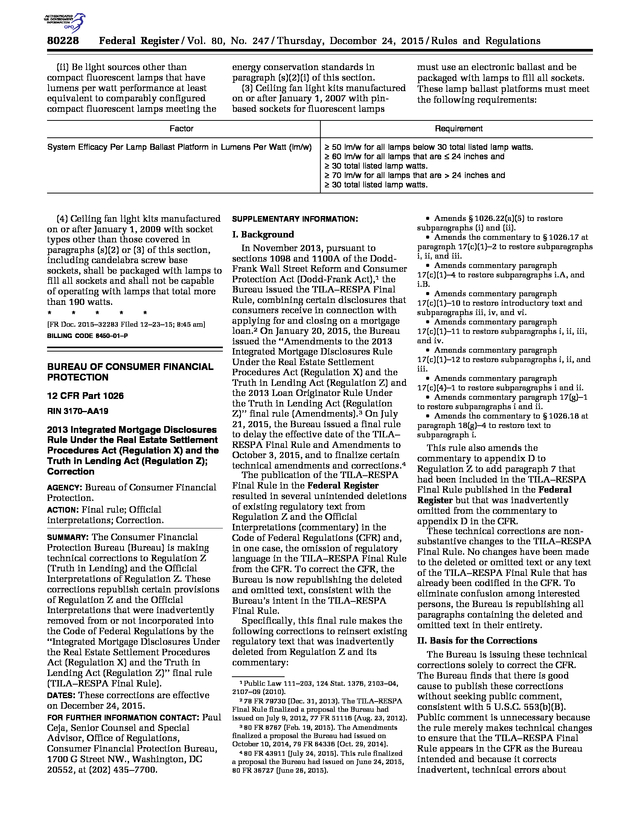
These corrections republish certain provisions of Regulation Z and the Official Interpretations that were inadvertently removed from or not incorporated into the Code of Federal Regulations by the ‘‘Integrated Mortgage Disclosures Under the Real Estate Settlement Procedures Act (Regulation X) and the Truth in Lending Act (Regulation Z)’’ final rule (TILA–RESPA Final Rule). DATES: These corrections are effective on December 24, 2015. FOR FURTHER INFORMATION CONTACT: Paul Ceja, Senior Counsel and Special Advisor, Office of Regulations, Consumer Financial Protection Bureau, 1700 G Street NW., Washington, DC 20552, at (202) 435–7700. tkelley on DSK3SPTVN1PROD with RULES SUMMARY: VerDate Sep<11>2014 17:12 Dec 23, 2015 Jkt 238001 must use an electronic ballast and be packaged with lamps to fill all sockets. These lamp ballast platforms must meet the following requirements: ≥ ≥ ≥ ≥ ≥ 50 60 30 70 30 lm/w for all lamps below 30 total listed lamp watts. lm/w for all lamps that are ≤ 24 inches and total listed lamp watts. lm/w for all lamps that are > 24 inches and total listed lamp watts. SUPPLEMENTARY INFORMATION: I. Background In November 2013, pursuant to sections 1098 and 1100A of the DoddFrank Wall Street Reform and Consumer Protection Act (Dodd-Frank Act),1 the Bureau issued the TILA–RESPA Final Rule, combining certain disclosures that consumers receive in connection with applying for and closing on a mortgage loan.2 On January 20, 2015, the Bureau issued the ‘‘Amendments to the 2013 Integrated Mortgage Disclosures Rule Under the Real Estate Settlement Procedures Act (Regulation X) and the Truth in Lending Act (Regulation Z) and the 2013 Loan Originator Rule Under the Truth in Lending Act (Regulation Z)’’ final rule (Amendments).3 On July 21, 2015, the Bureau issued a final rule to delay the effective date of the TILA– RESPA Final Rule and Amendments to October 3, 2015, and to finalize certain technical amendments and corrections.4 The publication of the TILA–RESPA Final Rule in the Federal Register resulted in several unintended deletions of existing regulatory text from Regulation Z and the Official Interpretations (commentary) in the Code of Federal Regulations (CFR) and, in one case, the omission of regulatory language in the TILA–RESPA Final Rule from the CFR. To correct the CFR, the Bureau is now republishing the deleted and omitted text, consistent with the Bureau’s intent in the TILA–RESPA Final Rule. Specifically, this final rule makes the following corrections to reinsert existing regulatory text that was inadvertently deleted from Regulation Z and its commentary: 1 Public Law 111–203, 124 Stat.
1376, 2103–04, 2107–09 (2010). 2 78 FR 79730 (Dec. 31, 2013). The TILA–RESPA Final Rule finalized a proposal the Bureau had issued on July 9, 2012, 77 FR 51116 (Aug.
23, 2012). 3 80 FR 8767 (Feb. 19, 2015). The Amendments finalized a proposal the Bureau had issued on October 10, 2014, 79 FR 64336 (Oct.
29, 2014). 4 80 FR 43911 (July 24, 2015). This rule finalized a proposal the Bureau had issued on June 24, 2015, 80 FR 36727 (June 26, 2015). PO 00000 Frm 00022 Fmt 4700 Sfmt 4700 • Amends § 1026.22(a)(5) to restore subparagraphs (i) and (ii). • Amends the commentary to § 1026.17 at paragraph 17(c)(1)–2 to restore subparagraphs i, ii, and iii. • Amends commentary paragraph 17(c)(1)–4 to restore subparagraphs i.A, and i.B. • Amends commentary paragraph 17(c)(1)–10 to restore introductory text and subparagraphs iii, iv, and vi. • Amends commentary paragraph 17(c)(1)–11 to restore subparagraphs i, ii, iii, and iv. • Amends commentary paragraph 17(c)(1)–12 to restore subparagraphs i, ii, and iii. • Amends commentary paragraph 17(c)(4)–1 to restore subparagraphs i and ii. • Amends commentary paragraph 17(g)–1 to restore subparagraphs i and ii. • Amends the commentary to § 1026.18 at paragraph 18(g)–4 to restore text to subparagraph i. This rule also amends the commentary to appendix D to Regulation Z to add paragraph 7 that had been included in the TILA–RESPA Final Rule published in the Federal Register but that was inadvertently omitted from the commentary to appendix D in the CFR. These technical corrections are nonsubstantive changes to the TILA–RESPA Final Rule. No changes have been made to the deleted or omitted text or any text of the TILA–RESPA Final Rule that has already been codified in the CFR.
To eliminate confusion among interested persons, the Bureau is republishing all paragraphs containing the deleted and omitted text in their entirety. II. Basis for the Corrections The Bureau is issuing these technical corrections solely to correct the CFR. The Bureau finds that there is good cause to publish these corrections without seeking public comment, consistent with 5 U.S.C. 553(b)(B). Public comment is unnecessary because the rule merely makes technical changes to ensure that the TILA–RESPA Final Rule appears in the CFR as the Bureau intended and because it corrects inadvertent, technical errors about E:\FR\FM\24DER1.SGM 24DER1 .
Federal Register / Vol. 80, No. 247 / Thursday, December 24, 2015 / Rules and Regulations which there is minimal, if any, basis for substantive disagreement. Additionally, the Bureau finds good cause to dispense with a 30-day delay of the effective date. See 5 U.S.C.
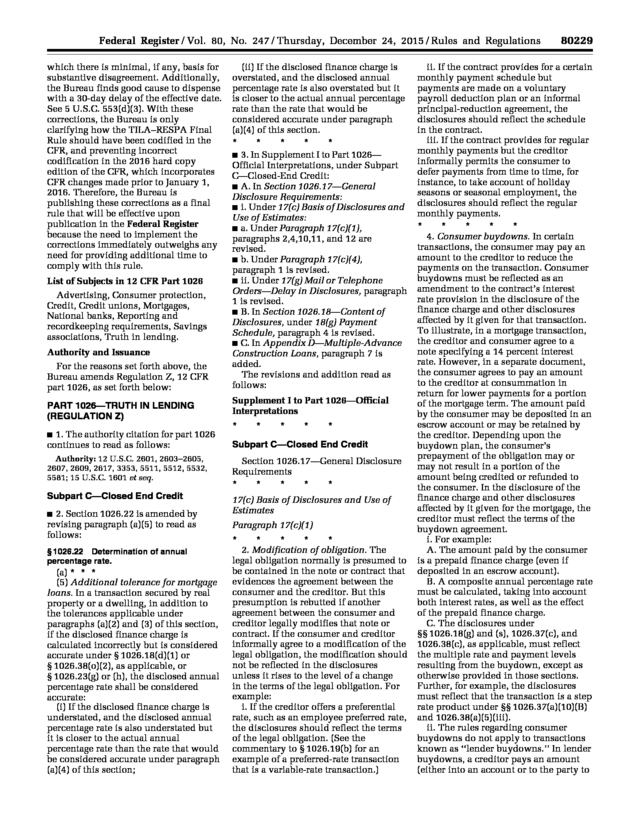
553(d)(3). With these corrections, the Bureau is only clarifying how the TILA–RESPA Final Rule should have been codified in the CFR, and preventing incorrect codification in the 2016 hard copy edition of the CFR, which incorporates CFR changes made prior to January 1, 2016. Therefore, the Bureau is publishing these corrections as a final rule that will be effective upon publication in the Federal Register because the need to implement the corrections immediately outweighs any need for providing additional time to comply with this rule. List of Subjects in 12 CFR Part 1026 Advertising, Consumer protection, Credit, Credit unions, Mortgages, National banks, Reporting and recordkeeping requirements, Savings associations, Truth in lending. Authority and Issuance For the reasons set forth above, the Bureau amends Regulation Z, 12 CFR part 1026, as set forth below: (ii) If the disclosed finance charge is overstated, and the disclosed annual percentage rate is also overstated but it is closer to the actual annual percentage rate than the rate that would be considered accurate under paragraph (a)(4) of this section. * * * * * â– 3.
In Supplement I to Part 1026— Official Interpretations, under Subpart C—Closed-End Credit: â– A. In Section 1026.17—General Disclosure Requirements: â– i. Under 17(c) Basis of Disclosures and Use of Estimates: â– a.
Under Paragraph 17(c)(1), paragraphs 2,4,10,11, and 12 are revised. â– b. Under Paragraph 17(c)(4), paragraph 1 is revised. â– ii. Under 17(g) Mail or Telephone Orders—Delay in Disclosures, paragraph 1 is revised. â– B.
In Section 1026.18—Content of Disclosures, under 18(g) Payment Schedule, paragraph 4 is revised. â– C. In Appendix D—Multiple-Advance Construction Loans, paragraph 7 is added. The revisions and addition read as follows: Supplement I to Part 1026—Official Interpretations PART 1026—TRUTH IN LENDING (REGULATION Z) 1. The authority citation for part 1026 continues to read as follows: * * * * * â– Subpart C—Closed End Credit Authority: 12 U.S.C.
2601, 2603–2605, 2607, 2609, 2617, 3353, 5511, 5512, 5532, 5581; 15 U.S.C. 1601 et seq. Section 1026.17—General Disclosure Requirements * * * * * Subpart C—Closed End Credit 17(c) Basis of Disclosures and Use of Estimates 2. Section 1026.22 is amended by revising paragraph (a)(5) to read as follows: â– Paragraph 17(c)(1) * tkelley on DSK3SPTVN1PROD with RULES § 1026.22 Determination of annual percentage rate. (a) * * * (5) Additional tolerance for mortgage loans.
In a transaction secured by real property or a dwelling, in addition to the tolerances applicable under paragraphs (a)(2) and (3) of this section, if the disclosed finance charge is calculated incorrectly but is considered accurate under § 1026.18(d)(1) or § 1026.38(o)(2), as applicable, or § 1026.23(g) or (h), the disclosed annual percentage rate shall be considered accurate: (i) If the disclosed finance charge is understated, and the disclosed annual percentage rate is also understated but it is closer to the actual annual percentage rate than the rate that would be considered accurate under paragraph (a)(4) of this section; VerDate Sep<11>2014 17:12 Dec 23, 2015 Jkt 238001 * * * * 2. Modification of obligation. The legal obligation normally is presumed to be contained in the note or contract that evidences the agreement between the consumer and the creditor.
But this presumption is rebutted if another agreement between the consumer and creditor legally modifies that note or contract. If the consumer and creditor informally agree to a modification of the legal obligation, the modification should not be reflected in the disclosures unless it rises to the level of a change in the terms of the legal obligation. For example: i.
If the creditor offers a preferential rate, such as an employee preferred rate, the disclosures should reflect the terms of the legal obligation. (See the commentary to § 1026.19(b) for an example of a preferred-rate transaction that is a variable-rate transaction.) PO 00000 Frm 00023 Fmt 4700 Sfmt 4700 80229 ii. If the contract provides for a certain monthly payment schedule but payments are made on a voluntary payroll deduction plan or an informal principal-reduction agreement, the disclosures should reflect the schedule in the contract. iii.
If the contract provides for regular monthly payments but the creditor informally permits the consumer to defer payments from time to time, for instance, to take account of holiday seasons or seasonal employment, the disclosures should reflect the regular monthly payments. * * * * * 4. Consumer buydowns. In certain transactions, the consumer may pay an amount to the creditor to reduce the payments on the transaction.
Consumer buydowns must be reflected as an amendment to the contract’s interest rate provision in the disclosure of the finance charge and other disclosures affected by it given for that transaction. To illustrate, in a mortgage transaction, the creditor and consumer agree to a note specifying a 14 percent interest rate. However, in a separate document, the consumer agrees to pay an amount to the creditor at consummation in return for lower payments for a portion of the mortgage term. The amount paid by the consumer may be deposited in an escrow account or may be retained by the creditor.
Depending upon the buydown plan, the consumer’s prepayment of the obligation may or may not result in a portion of the amount being credited or refunded to the consumer. In the disclosure of the finance charge and other disclosures affected by it given for the mortgage, the creditor must reflect the terms of the buydown agreement. i. For example: A.
The amount paid by the consumer is a prepaid finance charge (even if deposited in an escrow account). B. A composite annual percentage rate must be calculated, taking into account both interest rates, as well as the effect of the prepaid finance charge. C. The disclosures under §§ 1026.18(g) and (s), 1026.37(c), and 1026.38(c), as applicable, must reflect the multiple rate and payment levels resulting from the buydown, except as otherwise provided in those sections. Further, for example, the disclosures must reflect that the transaction is a step rate product under §§ 1026.37(a)(10)(B) and 1026.38(a)(5)(iii). ii.
The rules regarding consumer buydowns do not apply to transactions known as ‘‘lender buydowns.’’ In lender buydowns, a creditor pays an amount (either into an account or to the party to E:\FR\FM\24DER1.SGM 24DER1 . tkelley on DSK3SPTVN1PROD with RULES 80230 Federal Register / Vol. 80, No. 247 / Thursday, December 24, 2015 / Rules and Regulations whom the obligation is sold) to reduce the consumer’s payments or interest rate for all or a portion of the credit term. Typically, these transactions are structured as a buydown of the interest rate during an initial period of the transaction with a higher than usual rate for the remainder of the term. The disclosure of the finance charge and other disclosures affected by it for lender buydowns should be based on the terms of the legal obligation between the consumer and the creditor.
See comment 17(c)(1)–3 for the analogous rules concerning third-party buydowns. * * * * * 10. Discounted and premium variable-rate transactions. In some variable-rate transactions, creditors may set an initial interest rate that is not determined by the index or formula used to make later interest rate adjustments.
Typically, this initial rate charged to consumers is lower than the rate would be if it were calculated using the index or formula. However, in some cases the initial rate may be higher. In a discounted transaction, for example, a creditor may calculate interest rates according to a formula using the sixmonth Treasury bill rate plus a 2 percent margin.
If the Treasury bill rate at consummation is 10 percent, the creditor may forgo the 2 percent spread and charge only 10 percent for a limited time, instead of setting an initial rate of 12 percent. i. When creditors use an initial interest rate that is not calculated using the index or formula for later rate adjustments, the disclosures should reflect a composite annual percentage rate based on the initial rate for as long as it is charged and, for the remainder of the term, the rate that would have been applied using the index or formula at the time of consummation. The rate at consummation need not be used if a contract provides for a delay in the implementation of changes in an index value.
For example, if the contract specifies that rate changes are based on the index value in effect 45 days before the change date, creditors may use any index value in effect during the 45 day period before consummation in calculating a composite annual percentage rate. ii. The effect of the multiple rates must also be reflected in the calculation and disclosure of the finance charge, total of payments, and the disclosures required under §§ 1026.18(g) and (s), 1026.37(c), 1026.37(l)(1) and (3), 1026.38(c), and 1026.38(o)(5), as applicable. iii. If a loan contains a rate or payment cap that would prevent the VerDate Sep<11>2014 17:12 Dec 23, 2015 Jkt 238001 initial rate or payment, at the time of the first adjustment, from changing to the rate determined by the index or formula at consummation, the effect of that rate or payment cap should be reflected in the disclosures. iv.
Because these transactions involve irregular payment amounts, an annual percentage rate tolerance of 1⁄4 of 1 percent applies, in accordance with § 1026.22(a)(3). v. Examples of discounted variablerate transactions include: A. A 30-year loan for $100,000 with no prepaid finance charges and rates determined by the Treasury bill rate plus two percent.
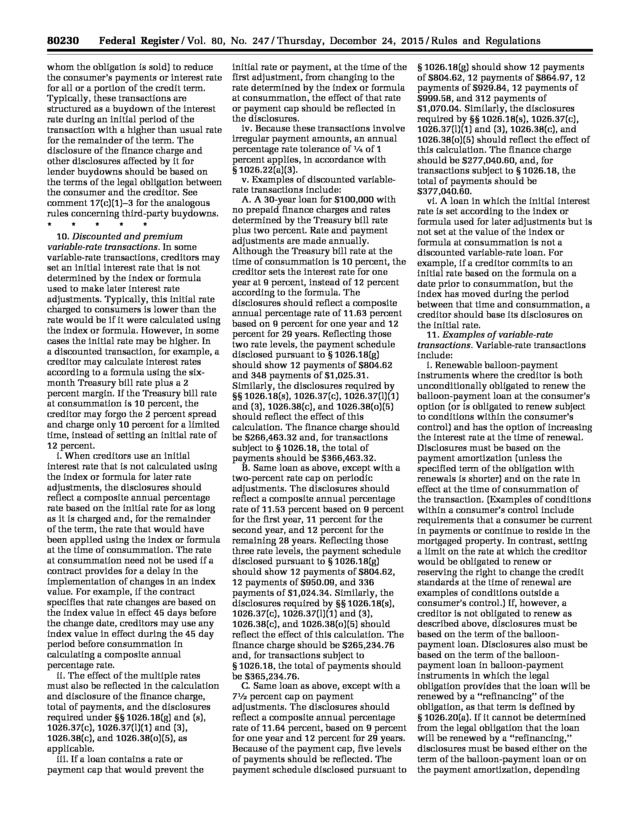
Rate and payment adjustments are made annually. Although the Treasury bill rate at the time of consummation is 10 percent, the creditor sets the interest rate for one year at 9 percent, instead of 12 percent according to the formula. The disclosures should reflect a composite annual percentage rate of 11.63 percent based on 9 percent for one year and 12 percent for 29 years. Reflecting those two rate levels, the payment schedule disclosed pursuant to § 1026.18(g) should show 12 payments of $804.62 and 348 payments of $1,025.31. Similarly, the disclosures required by §§ 1026.18(s), 1026.37(c), 1026.37(l)(1) and (3), 1026.38(c), and 1026.38(o)(5) should reflect the effect of this calculation.
The finance charge should be $266,463.32 and, for transactions subject to § 1026.18, the total of payments should be $366,463.32. B. Same loan as above, except with a two-percent rate cap on periodic adjustments. The disclosures should reflect a composite annual percentage rate of 11.53 percent based on 9 percent for the first year, 11 percent for the second year, and 12 percent for the remaining 28 years.
Reflecting those three rate levels, the payment schedule disclosed pursuant to § 1026.18(g) should show 12 payments of $804.62, 12 payments of $950.09, and 336 payments of $1,024.34. Similarly, the disclosures required by §§ 1026.18(s), 1026.37(c), 1026.37(l)(1) and (3), 1026.38(c), and 1026.38(o)(5) should reflect the effect of this calculation. The finance charge should be $265,234.76 and, for transactions subject to § 1026.18, the total of payments should be $365,234.76. C.
Same loan as above, except with a 71⁄2 percent cap on payment adjustments. The disclosures should reflect a composite annual percentage rate of 11.64 percent, based on 9 percent for one year and 12 percent for 29 years. Because of the payment cap, five levels of payments should be reflected. The payment schedule disclosed pursuant to PO 00000 Frm 00024 Fmt 4700 Sfmt 4700 § 1026.18(g) should show 12 payments of $804.62, 12 payments of $864.97, 12 payments of $929.84, 12 payments of $999.58, and 312 payments of $1,070.04.
Similarly, the disclosures required by §§ 1026.18(s), 1026.37(c), 1026.37(l)(1) and (3), 1026.38(c), and 1026.38(o)(5) should reflect the effect of this calculation. The finance charge should be $277,040.60, and, for transactions subject to § 1026.18, the total of payments should be $377,040.60. vi. A loan in which the initial interest rate is set according to the index or formula used for later adjustments but is not set at the value of the index or formula at consummation is not a discounted variable-rate loan.
For example, if a creditor commits to an initial rate based on the formula on a date prior to consummation, but the index has moved during the period between that time and consummation, a creditor should base its disclosures on the initial rate. 11. Examples of variable-rate transactions. Variable-rate transactions include: i.
Renewable balloon-payment instruments where the creditor is both unconditionally obligated to renew the balloon-payment loan at the consumer’s option (or is obligated to renew subject to conditions within the consumer’s control) and has the option of increasing the interest rate at the time of renewal. Disclosures must be based on the payment amortization (unless the specified term of the obligation with renewals is shorter) and on the rate in effect at the time of consummation of the transaction. (Examples of conditions within a consumer’s control include requirements that a consumer be current in payments or continue to reside in the mortgaged property. In contrast, setting a limit on the rate at which the creditor would be obligated to renew or reserving the right to change the credit standards at the time of renewal are examples of conditions outside a consumer’s control.) If, however, a creditor is not obligated to renew as described above, disclosures must be based on the term of the balloonpayment loan.
Disclosures also must be based on the term of the balloonpayment loan in balloon-payment instruments in which the legal obligation provides that the loan will be renewed by a ‘‘refinancing’’ of the obligation, as that term is defined by § 1026.20(a). If it cannot be determined from the legal obligation that the loan will be renewed by a ‘‘refinancing,’’ disclosures must be based either on the term of the balloon-payment loan or on the payment amortization, depending E:\FR\FM\24DER1.SGM 24DER1 . tkelley on DSK3SPTVN1PROD with RULES Federal Register / Vol. 80, No. 247 / Thursday, December 24, 2015 / Rules and Regulations on whether the creditor is unconditionally obligated to renew the loan as described above. (This discussion does not apply to construction loans subject to § 1026.17(c)(6).) ii.
‘‘Shared-equity’’ or ‘‘sharedappreciation’’ mortgages that have a fixed rate of interest and an appreciation share based on the consumer’s equity in the mortgaged property. The appreciation share is payable in a lump sum at a specified time. Disclosures must be based on the fixed interest rate. (As discussed in the commentary to § 1026.2, other types of shared-equity arrangements are not considered ‘‘credit’’ and are not subject to Regulation Z.) iii.
Preferred-rate loans where the terms of the legal obligation provide that the initial underlying rate is fixed but will increase upon the occurrence of some event, such as an employee leaving the employ of the creditor, and the note reflects the preferred rate. The disclosures are to be based on the preferred rate. iv. Graduated-payment mortgages and step-rate transactions without a variable-rate feature are not considered variable-rate transactions. v.
‘‘Price level adjusted mortgages’’ or other indexed mortgages that have a fixed rate of interest but provide for periodic adjustments to payments and the loan balance to reflect changes in an index measuring prices or inflation. Disclosures are to be based on the fixed interest rate, except as otherwise provided in §§ 1026.18(s), 1026.37, and 1026.38, as applicable. 12. Graduated payment adjustable rate mortgages. These mortgages involve both a variable interest rate and scheduled variations in payment amounts during the loan term.
For example, under these plans, a series of graduated payments may be scheduled before rate adjustments affect payment amounts, or the initial scheduled payment may remain constant for a set period before rate adjustments affect the payment amount. In any case, the initial payment amount may be insufficient to cover the scheduled interest, causing negative amortization from the outset of the transaction. In these transactions, except as otherwise provided in §§ 1026.18(s), 1026.37(c), and 1026.38(c), the disclosures should treat these features as follows: i.
The finance charge includes the amount of negative amortization based on the assumption that the rate in effect at consummation remains unchanged. ii. The amount financed does not include the amount of negative amortization. VerDate Sep<11>2014 17:12 Dec 23, 2015 Jkt 238001 iii. As in any variable-rate transaction, the annual percentage rate is based on the terms in effect at consummation. iv.
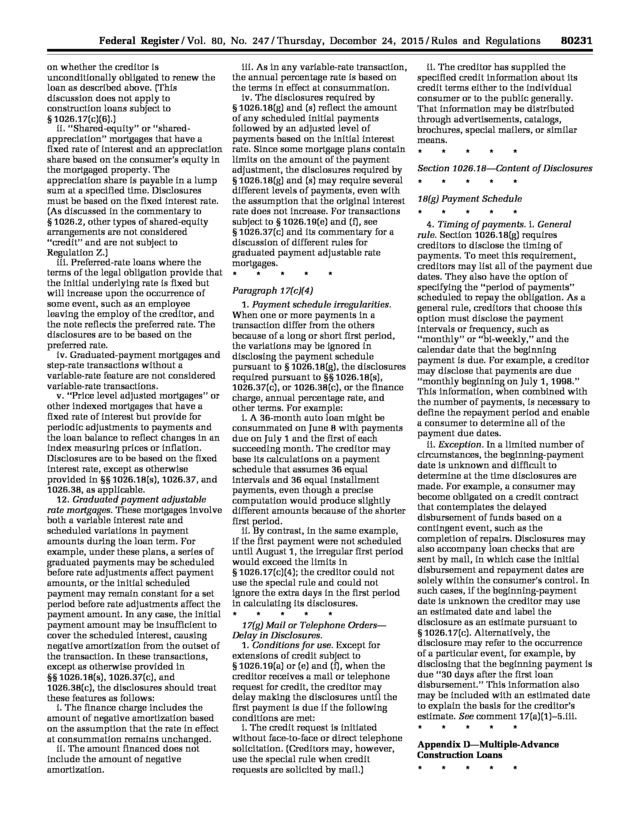
The disclosures required by § 1026.18(g) and (s) reflect the amount of any scheduled initial payments followed by an adjusted level of payments based on the initial interest rate. Since some mortgage plans contain limits on the amount of the payment adjustment, the disclosures required by § 1026.18(g) and (s) may require several different levels of payments, even with the assumption that the original interest rate does not increase. For transactions subject to § 1026.19(e) and (f), see § 1026.37(c) and its commentary for a discussion of different rules for graduated payment adjustable rate mortgages. * * * * * Paragraph 17(c)(4) 1.
Payment schedule irregularities. When one or more payments in a transaction differ from the others because of a long or short first period, the variations may be ignored in disclosing the payment schedule pursuant to § 1026.18(g), the disclosures required pursuant to §§ 1026.18(s), 1026.37(c), or 1026.38(c), or the finance charge, annual percentage rate, and other terms. For example: i. A 36-month auto loan might be consummated on June 8 with payments due on July 1 and the first of each succeeding month.
The creditor may base its calculations on a payment schedule that assumes 36 equal intervals and 36 equal installment payments, even though a precise computation would produce slightly different amounts because of the shorter first period. ii. By contrast, in the same example, if the first payment were not scheduled until August 1, the irregular first period would exceed the limits in § 1026.17(c)(4); the creditor could not use the special rule and could not ignore the extra days in the first period in calculating its disclosures. * * * * * 17(g) Mail or Telephone Orders— Delay in Disclosures. 1. Conditions for use.
Except for extensions of credit subject to § 1026.19(a) or (e) and (f), when the creditor receives a mail or telephone request for credit, the creditor may delay making the disclosures until the first payment is due if the following conditions are met: i. The credit request is initiated without face-to-face or direct telephone solicitation. (Creditors may, however, use the special rule when credit requests are solicited by mail.) PO 00000 Frm 00025 Fmt 4700 Sfmt 4700 80231 ii.
The creditor has supplied the specified credit information about its credit terms either to the individual consumer or to the public generally. That information may be distributed through advertisements, catalogs, brochures, special mailers, or similar means. * * * * * Section 1026.18—Content of Disclosures * * * * * 18(g) Payment Schedule * * * * * 4. Timing of payments. i.
General rule. Section 1026.18(g) requires creditors to disclose the timing of payments. To meet this requirement, creditors may list all of the payment due dates.
They also have the option of specifying the ‘‘period of payments’’ scheduled to repay the obligation. As a general rule, creditors that choose this option must disclose the payment intervals or frequency, such as ‘‘monthly’’ or ‘‘bi-weekly,’’ and the calendar date that the beginning payment is due. For example, a creditor may disclose that payments are due ‘‘monthly beginning on July 1, 1998.’’ This information, when combined with the number of payments, is necessary to define the repayment period and enable a consumer to determine all of the payment due dates. ii.
Exception. In a limited number of circumstances, the beginning-payment date is unknown and difficult to determine at the time disclosures are made. For example, a consumer may become obligated on a credit contract that contemplates the delayed disbursement of funds based on a contingent event, such as the completion of repairs.
Disclosures may also accompany loan checks that are sent by mail, in which case the initial disbursement and repayment dates are solely within the consumer’s control. In such cases, if the beginning-payment date is unknown the creditor may use an estimated date and label the disclosure as an estimate pursuant to § 1026.17(c). Alternatively, the disclosure may refer to the occurrence of a particular event, for example, by disclosing that the beginning payment is due ‘‘30 days after the first loan disbursement.’’ This information also may be included with an estimated date to explain the basis for the creditor’s estimate.
See comment 17(a)(1)–5.iii. * * * * * Appendix D—Multiple-Advance Construction Loans * E:\FR\FM\24DER1.SGM * * 24DER1 * * . tkelley on DSK3SPTVN1PROD with RULES 80232 Federal Register / Vol. 80, No. 247 / Thursday, December 24, 2015 / Rules and Regulations 7. Relation to §§ 1026.37 and 1026.38. A creditor must disclose a projected payments table for certain transactions secured by real property, pursuant to §§ 1026.37(c) and 1026.38(c), instead of the general payment schedule required by § 1026.18(g) or the interest rate and payments summary table required by § 1026.18(s).
Accordingly, some home construction loans that are secured by real property are subject to §§ 1026.37(c) and 1026.38(c) and not § 1026.18(g). See comment app. D–6 for a discussion of transactions that are subject to § 1026.18(s).
Under § 1026.17(c)(6)(ii), when a multiple-advance construction loan may be permanently financed by the same creditor, the construction phase and the permanent phase may be treated as either one transaction or more than one transaction. Following are illustrations of the application of appendix D to transactions subject to §§ 1026.37(c) and 1026.38(c), under each of these two alternatives: i. If a creditor uses appendix D and elects pursuant to § 1026.17(c)(6)(ii) to disclose the construction and permanent phases as separate transactions, the construction phase must be disclosed according to the rules in §§ 1026.37(c) and 1026.38(c).
Under §§ 1026.37(c) and 1026.38(c), the creditor must disclose the periodic payments during the construction phase in a projected payments table. The provision in appendix D, part I.A.3, which allows the creditor to omit the number and amounts of any interest payments ‘‘in disclosing the payment schedule under § 1026.18(g)’’ does not apply because the transaction is governed by §§ 1026.37(c) and 1026.38(c) rather than § 1026.18(g). The creditor determines the amount of the interest-only payment to be made during the construction phase using the assumption in appendix D, part I.A.1. Also, because the construction phase is being disclosed as a separate transaction and its terms do not repay all principal, the creditor must disclose the construction phase transaction as a product with a balloon payment feature, pursuant to §§ 1026.37(a)(10)(ii)(D) and 1026.38(a)(5)(iii), in addition to reflecting the balloon payment in the projected payments table. ii.
If the creditor elects to disclose the construction and permanent phases as a single transaction, the repayment schedule must be disclosed pursuant to appendix D, part II.C.2. Under appendix D, part II.C.2, the projected payments table must reflect the interest-only payments during the construction phase in a first column, followed by the appropriate column(s) reflecting the amortizing payments for the permanent VerDate Sep<11>2014 17:12 Dec 23, 2015 Jkt 238001 phase. The creditor determines the amount of the interest-only payment to be made during the construction phase using the assumption in appendix D, part II.A.1. * * * * * Dated: December 15, 2015. Richard Cordray, Director, Bureau of Consumer Financial Protection. [FR Doc.
2015–32463 Filed 12–21–15; 4:15 pm] BILLING CODE 4810–AM–P FEDERAL HOUSING FINANCE AGENCY 12 CFR Parts 1200, 1202, 1203, 1204, 1209, 1215, 1263, and 1264 RIN 2590–AA79 Technical Amendments: FHFA Address and Zip Code Change Federal Housing Finance Agency. ACTION: Final rule. AGENCY: The Federal Housing Finance Agency (FHFA) is issuing this final rule as a technical change to correct regulatory references to FHFA’s address and postal zip code. DATES: Effective December 24, 2015. For additional information, see SUPPLEMENTARY INFORMATION. FOR FURTHER INFORMATION CONTACT: Crystal Miller, Crystal.Miller@fhfa.gov, (202) 649–3079, Paralegal Specialist (not a toll-free number), Office of General Counsel, Federal Housing Finance Agency, Constitution Center, Eighth Floor (OGC), 400 7th Street SW., Washington, DC 20219. The telephone number for the Telecommunications Device for the Hearing Impaired is (800) 877–8339. SUPPLEMENTARY INFORMATION: SUMMARY: I.
Background FHFA Headquarters Address Change In January 2012, FHFA moved to a new headquarters building in Southwest Washington, DC. As a result, the addresses for FHFA’s former locations in Northwest Washington, DC, included in 12 CFR 1203.29, 1209.15(a), 1263.5(a)(2), and 1264.6(a) are now outof-date. This final rule amends those regulations to replace the FHFA’s former addresses with its current address, 400 7th Street SW., Washington, DC 20219. through a different mail processing facility.
This facility change required that FHFA use a new zip code. As a result, the zip code in the addresses for the FHFA included in 12 CFR 1200.1(b), 1200.2(g), 1202.3(c), 1202.5(a), 1202.9(a), 1204.3(b), 1204.5(b)(2), 1209.102(a)(1), and 1215.7(b) are now out-of-date. This final rule amends those regulations to replace the FHFA’s zip code, which changed from 20024 to 20219.
The street address of 400 7th Street SW., Washington, DC remains the same. FHFA submitted a change-of-address request to the local United States Post Office to forward mail containing the old zip code; however, mail addressed with the zip code 20024 after November 1, 2015, may result in delayed delivery to all FHFA offices. II. Notice and Comment Pursuant to the Administrative Procedure Act (APA), notice and comment are not required prior to the issuance of a final rule if an agency, for good cause, finds that ‘‘notice and public procedure thereon are impracticable, unnecessary, or contrary to the public interest.’’ 1 FHFA finds that public notice and comment on this final rule are unnecessary. The final rule’s update of FHFA’s address and postal zip code is purely a technical change to the Agency’s regulations and provides FHFA’s regulated entities, interested parties, and other members of the public with FHFA’s current and accurate location and mailing address information.
For these reasons, FHFA has good cause to conclude that advance notice and comment under the APA for this rulemaking are unnecessary. III. Effective Date This final rule is effective on December 24, 2015. Pursuant to the APA, a final rule may be effective without 30 days advance publication in the Federal Register if an agency finds good cause and publishes its finding with the final rule.2 As described above, the updates made by this final rule to FHFA’s physical addresses and zip code are technical changes and will have no substantive effect on FHFA’s regulated entities, interested parties, or other members of the public.
Therefore, the FHFA finds good cause to dispense with a delayed effective date. FHFA Zip Code Change Effective November 1, 2015, all mail addressed to FHFA is being processed PO 00000 Frm 00026 Fmt 4700 Sfmt 4700 15 25 U.S.C. 553(b). U.S.C. 553(d)(3). E:\FR\FM\24DER1.SGM 24DER1 .
.
These corrections republish certain provisions of Regulation Z and the Official Interpretations that were inadvertently removed from or not incorporated into the Code of Federal Regulations by the ‘‘Integrated Mortgage Disclosures Under the Real Estate Settlement Procedures Act (Regulation X) and the Truth in Lending Act (Regulation Z)’’ final rule (TILA–RESPA Final Rule). DATES: These corrections are effective on December 24, 2015. FOR FURTHER INFORMATION CONTACT: Paul Ceja, Senior Counsel and Special Advisor, Office of Regulations, Consumer Financial Protection Bureau, 1700 G Street NW., Washington, DC 20552, at (202) 435–7700. tkelley on DSK3SPTVN1PROD with RULES SUMMARY: VerDate Sep<11>2014 17:12 Dec 23, 2015 Jkt 238001 must use an electronic ballast and be packaged with lamps to fill all sockets. These lamp ballast platforms must meet the following requirements: ≥ ≥ ≥ ≥ ≥ 50 60 30 70 30 lm/w for all lamps below 30 total listed lamp watts. lm/w for all lamps that are ≤ 24 inches and total listed lamp watts. lm/w for all lamps that are > 24 inches and total listed lamp watts. SUPPLEMENTARY INFORMATION: I. Background In November 2013, pursuant to sections 1098 and 1100A of the DoddFrank Wall Street Reform and Consumer Protection Act (Dodd-Frank Act),1 the Bureau issued the TILA–RESPA Final Rule, combining certain disclosures that consumers receive in connection with applying for and closing on a mortgage loan.2 On January 20, 2015, the Bureau issued the ‘‘Amendments to the 2013 Integrated Mortgage Disclosures Rule Under the Real Estate Settlement Procedures Act (Regulation X) and the Truth in Lending Act (Regulation Z) and the 2013 Loan Originator Rule Under the Truth in Lending Act (Regulation Z)’’ final rule (Amendments).3 On July 21, 2015, the Bureau issued a final rule to delay the effective date of the TILA– RESPA Final Rule and Amendments to October 3, 2015, and to finalize certain technical amendments and corrections.4 The publication of the TILA–RESPA Final Rule in the Federal Register resulted in several unintended deletions of existing regulatory text from Regulation Z and the Official Interpretations (commentary) in the Code of Federal Regulations (CFR) and, in one case, the omission of regulatory language in the TILA–RESPA Final Rule from the CFR. To correct the CFR, the Bureau is now republishing the deleted and omitted text, consistent with the Bureau’s intent in the TILA–RESPA Final Rule. Specifically, this final rule makes the following corrections to reinsert existing regulatory text that was inadvertently deleted from Regulation Z and its commentary: 1 Public Law 111–203, 124 Stat.
1376, 2103–04, 2107–09 (2010). 2 78 FR 79730 (Dec. 31, 2013). The TILA–RESPA Final Rule finalized a proposal the Bureau had issued on July 9, 2012, 77 FR 51116 (Aug.
23, 2012). 3 80 FR 8767 (Feb. 19, 2015). The Amendments finalized a proposal the Bureau had issued on October 10, 2014, 79 FR 64336 (Oct.
29, 2014). 4 80 FR 43911 (July 24, 2015). This rule finalized a proposal the Bureau had issued on June 24, 2015, 80 FR 36727 (June 26, 2015). PO 00000 Frm 00022 Fmt 4700 Sfmt 4700 • Amends § 1026.22(a)(5) to restore subparagraphs (i) and (ii). • Amends the commentary to § 1026.17 at paragraph 17(c)(1)–2 to restore subparagraphs i, ii, and iii. • Amends commentary paragraph 17(c)(1)–4 to restore subparagraphs i.A, and i.B. • Amends commentary paragraph 17(c)(1)–10 to restore introductory text and subparagraphs iii, iv, and vi. • Amends commentary paragraph 17(c)(1)–11 to restore subparagraphs i, ii, iii, and iv. • Amends commentary paragraph 17(c)(1)–12 to restore subparagraphs i, ii, and iii. • Amends commentary paragraph 17(c)(4)–1 to restore subparagraphs i and ii. • Amends commentary paragraph 17(g)–1 to restore subparagraphs i and ii. • Amends the commentary to § 1026.18 at paragraph 18(g)–4 to restore text to subparagraph i. This rule also amends the commentary to appendix D to Regulation Z to add paragraph 7 that had been included in the TILA–RESPA Final Rule published in the Federal Register but that was inadvertently omitted from the commentary to appendix D in the CFR. These technical corrections are nonsubstantive changes to the TILA–RESPA Final Rule. No changes have been made to the deleted or omitted text or any text of the TILA–RESPA Final Rule that has already been codified in the CFR.
To eliminate confusion among interested persons, the Bureau is republishing all paragraphs containing the deleted and omitted text in their entirety. II. Basis for the Corrections The Bureau is issuing these technical corrections solely to correct the CFR. The Bureau finds that there is good cause to publish these corrections without seeking public comment, consistent with 5 U.S.C. 553(b)(B). Public comment is unnecessary because the rule merely makes technical changes to ensure that the TILA–RESPA Final Rule appears in the CFR as the Bureau intended and because it corrects inadvertent, technical errors about E:\FR\FM\24DER1.SGM 24DER1 .
Federal Register / Vol. 80, No. 247 / Thursday, December 24, 2015 / Rules and Regulations which there is minimal, if any, basis for substantive disagreement. Additionally, the Bureau finds good cause to dispense with a 30-day delay of the effective date. See 5 U.S.C.
553(d)(3). With these corrections, the Bureau is only clarifying how the TILA–RESPA Final Rule should have been codified in the CFR, and preventing incorrect codification in the 2016 hard copy edition of the CFR, which incorporates CFR changes made prior to January 1, 2016. Therefore, the Bureau is publishing these corrections as a final rule that will be effective upon publication in the Federal Register because the need to implement the corrections immediately outweighs any need for providing additional time to comply with this rule. List of Subjects in 12 CFR Part 1026 Advertising, Consumer protection, Credit, Credit unions, Mortgages, National banks, Reporting and recordkeeping requirements, Savings associations, Truth in lending. Authority and Issuance For the reasons set forth above, the Bureau amends Regulation Z, 12 CFR part 1026, as set forth below: (ii) If the disclosed finance charge is overstated, and the disclosed annual percentage rate is also overstated but it is closer to the actual annual percentage rate than the rate that would be considered accurate under paragraph (a)(4) of this section. * * * * * â– 3.
In Supplement I to Part 1026— Official Interpretations, under Subpart C—Closed-End Credit: â– A. In Section 1026.17—General Disclosure Requirements: â– i. Under 17(c) Basis of Disclosures and Use of Estimates: â– a.
Under Paragraph 17(c)(1), paragraphs 2,4,10,11, and 12 are revised. â– b. Under Paragraph 17(c)(4), paragraph 1 is revised. â– ii. Under 17(g) Mail or Telephone Orders—Delay in Disclosures, paragraph 1 is revised. â– B.
In Section 1026.18—Content of Disclosures, under 18(g) Payment Schedule, paragraph 4 is revised. â– C. In Appendix D—Multiple-Advance Construction Loans, paragraph 7 is added. The revisions and addition read as follows: Supplement I to Part 1026—Official Interpretations PART 1026—TRUTH IN LENDING (REGULATION Z) 1. The authority citation for part 1026 continues to read as follows: * * * * * â– Subpart C—Closed End Credit Authority: 12 U.S.C.
2601, 2603–2605, 2607, 2609, 2617, 3353, 5511, 5512, 5532, 5581; 15 U.S.C. 1601 et seq. Section 1026.17—General Disclosure Requirements * * * * * Subpart C—Closed End Credit 17(c) Basis of Disclosures and Use of Estimates 2. Section 1026.22 is amended by revising paragraph (a)(5) to read as follows: â– Paragraph 17(c)(1) * tkelley on DSK3SPTVN1PROD with RULES § 1026.22 Determination of annual percentage rate. (a) * * * (5) Additional tolerance for mortgage loans.
In a transaction secured by real property or a dwelling, in addition to the tolerances applicable under paragraphs (a)(2) and (3) of this section, if the disclosed finance charge is calculated incorrectly but is considered accurate under § 1026.18(d)(1) or § 1026.38(o)(2), as applicable, or § 1026.23(g) or (h), the disclosed annual percentage rate shall be considered accurate: (i) If the disclosed finance charge is understated, and the disclosed annual percentage rate is also understated but it is closer to the actual annual percentage rate than the rate that would be considered accurate under paragraph (a)(4) of this section; VerDate Sep<11>2014 17:12 Dec 23, 2015 Jkt 238001 * * * * 2. Modification of obligation. The legal obligation normally is presumed to be contained in the note or contract that evidences the agreement between the consumer and the creditor.
But this presumption is rebutted if another agreement between the consumer and creditor legally modifies that note or contract. If the consumer and creditor informally agree to a modification of the legal obligation, the modification should not be reflected in the disclosures unless it rises to the level of a change in the terms of the legal obligation. For example: i.
If the creditor offers a preferential rate, such as an employee preferred rate, the disclosures should reflect the terms of the legal obligation. (See the commentary to § 1026.19(b) for an example of a preferred-rate transaction that is a variable-rate transaction.) PO 00000 Frm 00023 Fmt 4700 Sfmt 4700 80229 ii. If the contract provides for a certain monthly payment schedule but payments are made on a voluntary payroll deduction plan or an informal principal-reduction agreement, the disclosures should reflect the schedule in the contract. iii.
If the contract provides for regular monthly payments but the creditor informally permits the consumer to defer payments from time to time, for instance, to take account of holiday seasons or seasonal employment, the disclosures should reflect the regular monthly payments. * * * * * 4. Consumer buydowns. In certain transactions, the consumer may pay an amount to the creditor to reduce the payments on the transaction.
Consumer buydowns must be reflected as an amendment to the contract’s interest rate provision in the disclosure of the finance charge and other disclosures affected by it given for that transaction. To illustrate, in a mortgage transaction, the creditor and consumer agree to a note specifying a 14 percent interest rate. However, in a separate document, the consumer agrees to pay an amount to the creditor at consummation in return for lower payments for a portion of the mortgage term. The amount paid by the consumer may be deposited in an escrow account or may be retained by the creditor.
Depending upon the buydown plan, the consumer’s prepayment of the obligation may or may not result in a portion of the amount being credited or refunded to the consumer. In the disclosure of the finance charge and other disclosures affected by it given for the mortgage, the creditor must reflect the terms of the buydown agreement. i. For example: A.
The amount paid by the consumer is a prepaid finance charge (even if deposited in an escrow account). B. A composite annual percentage rate must be calculated, taking into account both interest rates, as well as the effect of the prepaid finance charge. C. The disclosures under §§ 1026.18(g) and (s), 1026.37(c), and 1026.38(c), as applicable, must reflect the multiple rate and payment levels resulting from the buydown, except as otherwise provided in those sections. Further, for example, the disclosures must reflect that the transaction is a step rate product under §§ 1026.37(a)(10)(B) and 1026.38(a)(5)(iii). ii.
The rules regarding consumer buydowns do not apply to transactions known as ‘‘lender buydowns.’’ In lender buydowns, a creditor pays an amount (either into an account or to the party to E:\FR\FM\24DER1.SGM 24DER1 . tkelley on DSK3SPTVN1PROD with RULES 80230 Federal Register / Vol. 80, No. 247 / Thursday, December 24, 2015 / Rules and Regulations whom the obligation is sold) to reduce the consumer’s payments or interest rate for all or a portion of the credit term. Typically, these transactions are structured as a buydown of the interest rate during an initial period of the transaction with a higher than usual rate for the remainder of the term. The disclosure of the finance charge and other disclosures affected by it for lender buydowns should be based on the terms of the legal obligation between the consumer and the creditor.
See comment 17(c)(1)–3 for the analogous rules concerning third-party buydowns. * * * * * 10. Discounted and premium variable-rate transactions. In some variable-rate transactions, creditors may set an initial interest rate that is not determined by the index or formula used to make later interest rate adjustments.
Typically, this initial rate charged to consumers is lower than the rate would be if it were calculated using the index or formula. However, in some cases the initial rate may be higher. In a discounted transaction, for example, a creditor may calculate interest rates according to a formula using the sixmonth Treasury bill rate plus a 2 percent margin.
If the Treasury bill rate at consummation is 10 percent, the creditor may forgo the 2 percent spread and charge only 10 percent for a limited time, instead of setting an initial rate of 12 percent. i. When creditors use an initial interest rate that is not calculated using the index or formula for later rate adjustments, the disclosures should reflect a composite annual percentage rate based on the initial rate for as long as it is charged and, for the remainder of the term, the rate that would have been applied using the index or formula at the time of consummation. The rate at consummation need not be used if a contract provides for a delay in the implementation of changes in an index value.
For example, if the contract specifies that rate changes are based on the index value in effect 45 days before the change date, creditors may use any index value in effect during the 45 day period before consummation in calculating a composite annual percentage rate. ii. The effect of the multiple rates must also be reflected in the calculation and disclosure of the finance charge, total of payments, and the disclosures required under §§ 1026.18(g) and (s), 1026.37(c), 1026.37(l)(1) and (3), 1026.38(c), and 1026.38(o)(5), as applicable. iii. If a loan contains a rate or payment cap that would prevent the VerDate Sep<11>2014 17:12 Dec 23, 2015 Jkt 238001 initial rate or payment, at the time of the first adjustment, from changing to the rate determined by the index or formula at consummation, the effect of that rate or payment cap should be reflected in the disclosures. iv.
Because these transactions involve irregular payment amounts, an annual percentage rate tolerance of 1⁄4 of 1 percent applies, in accordance with § 1026.22(a)(3). v. Examples of discounted variablerate transactions include: A. A 30-year loan for $100,000 with no prepaid finance charges and rates determined by the Treasury bill rate plus two percent.
Rate and payment adjustments are made annually. Although the Treasury bill rate at the time of consummation is 10 percent, the creditor sets the interest rate for one year at 9 percent, instead of 12 percent according to the formula. The disclosures should reflect a composite annual percentage rate of 11.63 percent based on 9 percent for one year and 12 percent for 29 years. Reflecting those two rate levels, the payment schedule disclosed pursuant to § 1026.18(g) should show 12 payments of $804.62 and 348 payments of $1,025.31. Similarly, the disclosures required by §§ 1026.18(s), 1026.37(c), 1026.37(l)(1) and (3), 1026.38(c), and 1026.38(o)(5) should reflect the effect of this calculation.
The finance charge should be $266,463.32 and, for transactions subject to § 1026.18, the total of payments should be $366,463.32. B. Same loan as above, except with a two-percent rate cap on periodic adjustments. The disclosures should reflect a composite annual percentage rate of 11.53 percent based on 9 percent for the first year, 11 percent for the second year, and 12 percent for the remaining 28 years.
Reflecting those three rate levels, the payment schedule disclosed pursuant to § 1026.18(g) should show 12 payments of $804.62, 12 payments of $950.09, and 336 payments of $1,024.34. Similarly, the disclosures required by §§ 1026.18(s), 1026.37(c), 1026.37(l)(1) and (3), 1026.38(c), and 1026.38(o)(5) should reflect the effect of this calculation. The finance charge should be $265,234.76 and, for transactions subject to § 1026.18, the total of payments should be $365,234.76. C.
Same loan as above, except with a 71⁄2 percent cap on payment adjustments. The disclosures should reflect a composite annual percentage rate of 11.64 percent, based on 9 percent for one year and 12 percent for 29 years. Because of the payment cap, five levels of payments should be reflected. The payment schedule disclosed pursuant to PO 00000 Frm 00024 Fmt 4700 Sfmt 4700 § 1026.18(g) should show 12 payments of $804.62, 12 payments of $864.97, 12 payments of $929.84, 12 payments of $999.58, and 312 payments of $1,070.04.
Similarly, the disclosures required by §§ 1026.18(s), 1026.37(c), 1026.37(l)(1) and (3), 1026.38(c), and 1026.38(o)(5) should reflect the effect of this calculation. The finance charge should be $277,040.60, and, for transactions subject to § 1026.18, the total of payments should be $377,040.60. vi. A loan in which the initial interest rate is set according to the index or formula used for later adjustments but is not set at the value of the index or formula at consummation is not a discounted variable-rate loan.
For example, if a creditor commits to an initial rate based on the formula on a date prior to consummation, but the index has moved during the period between that time and consummation, a creditor should base its disclosures on the initial rate. 11. Examples of variable-rate transactions. Variable-rate transactions include: i.
Renewable balloon-payment instruments where the creditor is both unconditionally obligated to renew the balloon-payment loan at the consumer’s option (or is obligated to renew subject to conditions within the consumer’s control) and has the option of increasing the interest rate at the time of renewal. Disclosures must be based on the payment amortization (unless the specified term of the obligation with renewals is shorter) and on the rate in effect at the time of consummation of the transaction. (Examples of conditions within a consumer’s control include requirements that a consumer be current in payments or continue to reside in the mortgaged property. In contrast, setting a limit on the rate at which the creditor would be obligated to renew or reserving the right to change the credit standards at the time of renewal are examples of conditions outside a consumer’s control.) If, however, a creditor is not obligated to renew as described above, disclosures must be based on the term of the balloonpayment loan.
Disclosures also must be based on the term of the balloonpayment loan in balloon-payment instruments in which the legal obligation provides that the loan will be renewed by a ‘‘refinancing’’ of the obligation, as that term is defined by § 1026.20(a). If it cannot be determined from the legal obligation that the loan will be renewed by a ‘‘refinancing,’’ disclosures must be based either on the term of the balloon-payment loan or on the payment amortization, depending E:\FR\FM\24DER1.SGM 24DER1 . tkelley on DSK3SPTVN1PROD with RULES Federal Register / Vol. 80, No. 247 / Thursday, December 24, 2015 / Rules and Regulations on whether the creditor is unconditionally obligated to renew the loan as described above. (This discussion does not apply to construction loans subject to § 1026.17(c)(6).) ii.
‘‘Shared-equity’’ or ‘‘sharedappreciation’’ mortgages that have a fixed rate of interest and an appreciation share based on the consumer’s equity in the mortgaged property. The appreciation share is payable in a lump sum at a specified time. Disclosures must be based on the fixed interest rate. (As discussed in the commentary to § 1026.2, other types of shared-equity arrangements are not considered ‘‘credit’’ and are not subject to Regulation Z.) iii.
Preferred-rate loans where the terms of the legal obligation provide that the initial underlying rate is fixed but will increase upon the occurrence of some event, such as an employee leaving the employ of the creditor, and the note reflects the preferred rate. The disclosures are to be based on the preferred rate. iv. Graduated-payment mortgages and step-rate transactions without a variable-rate feature are not considered variable-rate transactions. v.
‘‘Price level adjusted mortgages’’ or other indexed mortgages that have a fixed rate of interest but provide for periodic adjustments to payments and the loan balance to reflect changes in an index measuring prices or inflation. Disclosures are to be based on the fixed interest rate, except as otherwise provided in §§ 1026.18(s), 1026.37, and 1026.38, as applicable. 12. Graduated payment adjustable rate mortgages. These mortgages involve both a variable interest rate and scheduled variations in payment amounts during the loan term.
For example, under these plans, a series of graduated payments may be scheduled before rate adjustments affect payment amounts, or the initial scheduled payment may remain constant for a set period before rate adjustments affect the payment amount. In any case, the initial payment amount may be insufficient to cover the scheduled interest, causing negative amortization from the outset of the transaction. In these transactions, except as otherwise provided in §§ 1026.18(s), 1026.37(c), and 1026.38(c), the disclosures should treat these features as follows: i.
The finance charge includes the amount of negative amortization based on the assumption that the rate in effect at consummation remains unchanged. ii. The amount financed does not include the amount of negative amortization. VerDate Sep<11>2014 17:12 Dec 23, 2015 Jkt 238001 iii. As in any variable-rate transaction, the annual percentage rate is based on the terms in effect at consummation. iv.
The disclosures required by § 1026.18(g) and (s) reflect the amount of any scheduled initial payments followed by an adjusted level of payments based on the initial interest rate. Since some mortgage plans contain limits on the amount of the payment adjustment, the disclosures required by § 1026.18(g) and (s) may require several different levels of payments, even with the assumption that the original interest rate does not increase. For transactions subject to § 1026.19(e) and (f), see § 1026.37(c) and its commentary for a discussion of different rules for graduated payment adjustable rate mortgages. * * * * * Paragraph 17(c)(4) 1.
Payment schedule irregularities. When one or more payments in a transaction differ from the others because of a long or short first period, the variations may be ignored in disclosing the payment schedule pursuant to § 1026.18(g), the disclosures required pursuant to §§ 1026.18(s), 1026.37(c), or 1026.38(c), or the finance charge, annual percentage rate, and other terms. For example: i. A 36-month auto loan might be consummated on June 8 with payments due on July 1 and the first of each succeeding month.
The creditor may base its calculations on a payment schedule that assumes 36 equal intervals and 36 equal installment payments, even though a precise computation would produce slightly different amounts because of the shorter first period. ii. By contrast, in the same example, if the first payment were not scheduled until August 1, the irregular first period would exceed the limits in § 1026.17(c)(4); the creditor could not use the special rule and could not ignore the extra days in the first period in calculating its disclosures. * * * * * 17(g) Mail or Telephone Orders— Delay in Disclosures. 1. Conditions for use.
Except for extensions of credit subject to § 1026.19(a) or (e) and (f), when the creditor receives a mail or telephone request for credit, the creditor may delay making the disclosures until the first payment is due if the following conditions are met: i. The credit request is initiated without face-to-face or direct telephone solicitation. (Creditors may, however, use the special rule when credit requests are solicited by mail.) PO 00000 Frm 00025 Fmt 4700 Sfmt 4700 80231 ii.
The creditor has supplied the specified credit information about its credit terms either to the individual consumer or to the public generally. That information may be distributed through advertisements, catalogs, brochures, special mailers, or similar means. * * * * * Section 1026.18—Content of Disclosures * * * * * 18(g) Payment Schedule * * * * * 4. Timing of payments. i.
General rule. Section 1026.18(g) requires creditors to disclose the timing of payments. To meet this requirement, creditors may list all of the payment due dates.
They also have the option of specifying the ‘‘period of payments’’ scheduled to repay the obligation. As a general rule, creditors that choose this option must disclose the payment intervals or frequency, such as ‘‘monthly’’ or ‘‘bi-weekly,’’ and the calendar date that the beginning payment is due. For example, a creditor may disclose that payments are due ‘‘monthly beginning on July 1, 1998.’’ This information, when combined with the number of payments, is necessary to define the repayment period and enable a consumer to determine all of the payment due dates. ii.
Exception. In a limited number of circumstances, the beginning-payment date is unknown and difficult to determine at the time disclosures are made. For example, a consumer may become obligated on a credit contract that contemplates the delayed disbursement of funds based on a contingent event, such as the completion of repairs.
Disclosures may also accompany loan checks that are sent by mail, in which case the initial disbursement and repayment dates are solely within the consumer’s control. In such cases, if the beginning-payment date is unknown the creditor may use an estimated date and label the disclosure as an estimate pursuant to § 1026.17(c). Alternatively, the disclosure may refer to the occurrence of a particular event, for example, by disclosing that the beginning payment is due ‘‘30 days after the first loan disbursement.’’ This information also may be included with an estimated date to explain the basis for the creditor’s estimate.
See comment 17(a)(1)–5.iii. * * * * * Appendix D—Multiple-Advance Construction Loans * E:\FR\FM\24DER1.SGM * * 24DER1 * * . tkelley on DSK3SPTVN1PROD with RULES 80232 Federal Register / Vol. 80, No. 247 / Thursday, December 24, 2015 / Rules and Regulations 7. Relation to §§ 1026.37 and 1026.38. A creditor must disclose a projected payments table for certain transactions secured by real property, pursuant to §§ 1026.37(c) and 1026.38(c), instead of the general payment schedule required by § 1026.18(g) or the interest rate and payments summary table required by § 1026.18(s).
Accordingly, some home construction loans that are secured by real property are subject to §§ 1026.37(c) and 1026.38(c) and not § 1026.18(g). See comment app. D–6 for a discussion of transactions that are subject to § 1026.18(s).
Under § 1026.17(c)(6)(ii), when a multiple-advance construction loan may be permanently financed by the same creditor, the construction phase and the permanent phase may be treated as either one transaction or more than one transaction. Following are illustrations of the application of appendix D to transactions subject to §§ 1026.37(c) and 1026.38(c), under each of these two alternatives: i. If a creditor uses appendix D and elects pursuant to § 1026.17(c)(6)(ii) to disclose the construction and permanent phases as separate transactions, the construction phase must be disclosed according to the rules in §§ 1026.37(c) and 1026.38(c).
Under §§ 1026.37(c) and 1026.38(c), the creditor must disclose the periodic payments during the construction phase in a projected payments table. The provision in appendix D, part I.A.3, which allows the creditor to omit the number and amounts of any interest payments ‘‘in disclosing the payment schedule under § 1026.18(g)’’ does not apply because the transaction is governed by §§ 1026.37(c) and 1026.38(c) rather than § 1026.18(g). The creditor determines the amount of the interest-only payment to be made during the construction phase using the assumption in appendix D, part I.A.1. Also, because the construction phase is being disclosed as a separate transaction and its terms do not repay all principal, the creditor must disclose the construction phase transaction as a product with a balloon payment feature, pursuant to §§ 1026.37(a)(10)(ii)(D) and 1026.38(a)(5)(iii), in addition to reflecting the balloon payment in the projected payments table. ii.
If the creditor elects to disclose the construction and permanent phases as a single transaction, the repayment schedule must be disclosed pursuant to appendix D, part II.C.2. Under appendix D, part II.C.2, the projected payments table must reflect the interest-only payments during the construction phase in a first column, followed by the appropriate column(s) reflecting the amortizing payments for the permanent VerDate Sep<11>2014 17:12 Dec 23, 2015 Jkt 238001 phase. The creditor determines the amount of the interest-only payment to be made during the construction phase using the assumption in appendix D, part II.A.1. * * * * * Dated: December 15, 2015. Richard Cordray, Director, Bureau of Consumer Financial Protection. [FR Doc.
2015–32463 Filed 12–21–15; 4:15 pm] BILLING CODE 4810–AM–P FEDERAL HOUSING FINANCE AGENCY 12 CFR Parts 1200, 1202, 1203, 1204, 1209, 1215, 1263, and 1264 RIN 2590–AA79 Technical Amendments: FHFA Address and Zip Code Change Federal Housing Finance Agency. ACTION: Final rule. AGENCY: The Federal Housing Finance Agency (FHFA) is issuing this final rule as a technical change to correct regulatory references to FHFA’s address and postal zip code. DATES: Effective December 24, 2015. For additional information, see SUPPLEMENTARY INFORMATION. FOR FURTHER INFORMATION CONTACT: Crystal Miller, Crystal.Miller@fhfa.gov, (202) 649–3079, Paralegal Specialist (not a toll-free number), Office of General Counsel, Federal Housing Finance Agency, Constitution Center, Eighth Floor (OGC), 400 7th Street SW., Washington, DC 20219. The telephone number for the Telecommunications Device for the Hearing Impaired is (800) 877–8339. SUPPLEMENTARY INFORMATION: SUMMARY: I.
Background FHFA Headquarters Address Change In January 2012, FHFA moved to a new headquarters building in Southwest Washington, DC. As a result, the addresses for FHFA’s former locations in Northwest Washington, DC, included in 12 CFR 1203.29, 1209.15(a), 1263.5(a)(2), and 1264.6(a) are now outof-date. This final rule amends those regulations to replace the FHFA’s former addresses with its current address, 400 7th Street SW., Washington, DC 20219. through a different mail processing facility.
This facility change required that FHFA use a new zip code. As a result, the zip code in the addresses for the FHFA included in 12 CFR 1200.1(b), 1200.2(g), 1202.3(c), 1202.5(a), 1202.9(a), 1204.3(b), 1204.5(b)(2), 1209.102(a)(1), and 1215.7(b) are now out-of-date. This final rule amends those regulations to replace the FHFA’s zip code, which changed from 20024 to 20219.
The street address of 400 7th Street SW., Washington, DC remains the same. FHFA submitted a change-of-address request to the local United States Post Office to forward mail containing the old zip code; however, mail addressed with the zip code 20024 after November 1, 2015, may result in delayed delivery to all FHFA offices. II. Notice and Comment Pursuant to the Administrative Procedure Act (APA), notice and comment are not required prior to the issuance of a final rule if an agency, for good cause, finds that ‘‘notice and public procedure thereon are impracticable, unnecessary, or contrary to the public interest.’’ 1 FHFA finds that public notice and comment on this final rule are unnecessary. The final rule’s update of FHFA’s address and postal zip code is purely a technical change to the Agency’s regulations and provides FHFA’s regulated entities, interested parties, and other members of the public with FHFA’s current and accurate location and mailing address information.
For these reasons, FHFA has good cause to conclude that advance notice and comment under the APA for this rulemaking are unnecessary. III. Effective Date This final rule is effective on December 24, 2015. Pursuant to the APA, a final rule may be effective without 30 days advance publication in the Federal Register if an agency finds good cause and publishes its finding with the final rule.2 As described above, the updates made by this final rule to FHFA’s physical addresses and zip code are technical changes and will have no substantive effect on FHFA’s regulated entities, interested parties, or other members of the public.
Therefore, the FHFA finds good cause to dispense with a delayed effective date. FHFA Zip Code Change Effective November 1, 2015, all mail addressed to FHFA is being processed PO 00000 Frm 00026 Fmt 4700 Sfmt 4700 15 25 U.S.C. 553(b). U.S.C. 553(d)(3). E:\FR\FM\24DER1.SGM 24DER1 .
.


